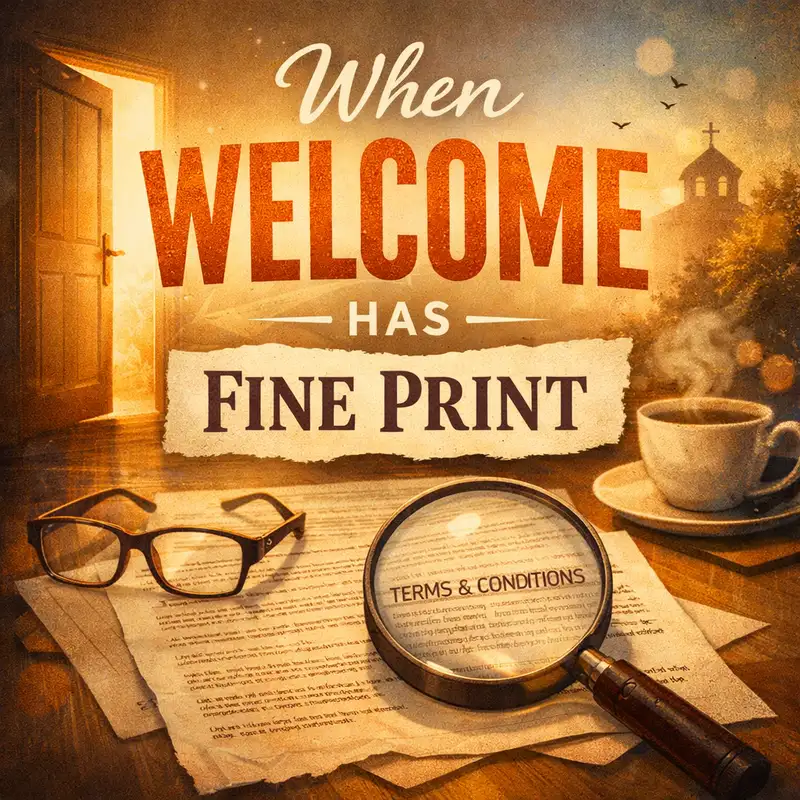
When Welcome Has Fine Print
Hey, y'all. Welcome to spiritual not religious. This is a podcast for young adults that explores
Mollie:the intricacies of God's kingdom and the modern world.
Shawn:Hey, friends, and welcome back to another episode of spiritual, not religious. I'm your host, Shawn Winburn, and I am joined by my wonderful cohost, yours and my favorite Aramaic linguistic genius, James Henry. And he is joined by our most favorite interior decorator diva on her way to becoming an all star Methodist deacon, Mollie June Miller Bachman. Together, we form the trinity of all things spiritual, not religious. And we are once again blessed beyond belief that you're listening in and hope this podcast is in some small way helpful in your journey into your thoughts about belief and God and faith, the church, and how it all connects to us and what we hope translates into a very relevant way to your life.
Shawn:And in appreciation to our listeners, we do want to give a shout out to one of our faithful listeners, Butch Barton. Yeah. That's right. Woo hoo. Talk to If you are looking for a guy who is always about doing the right thing and is just one of the best humans ever given to humanity, then Butch is your kind of guy.
Shawn:Thank you Butch for not only being you, but for your faithful following of this podcast and for just how super awesome you are to all of us. So here's looking at you Butch. Alright. And in this podcast, we are going to take a look at the mismatched messages that seem to be received by so many that claim to be spiritual, religious. These mismatched messages are things that come from faith communities and cause a lot of disagreement and confusion perhaps.
Shawn:On the one hand, there's the message of hope and love and renewal given to every human on the face of this planet that you might hear from these faith communities. And on the other, there tends to be a message of hate or discord and rejection of anyone not living a certain lifestyle. Both of these messages are coming from the same kinds of faith communities. But these mismatched messages have become a source of, like I said, confusion and frustration, disillusionment, and in the worst case, just plain rejection of who God is. Maybe a rejection of the church and the belief that a message of hope and transformation really has no weight or substance.
Shawn:So you're asking, what's the point? So James and Molly, let's start first by you guys catching us up on how you guys are doing and what is new in your world. James, how's it going up there in North Virginia?
James:It is lovely. We had snow overnight and it shut everything down and now it's all melting. So that is kind of how things are in lovely Northern Virginia. How about down there in Tennessee, Molly? How are things down there?
Mollie:They're good. It's kind of funny. We had like, 70 degree weather, like, two days ago, and now it's, like, 29 and flurrying and cold. And so the weather is confused as am I. Being a New Jerseyan, this is definitely different for me, but it has been kind of a nice to get those nice warm days with the sun on your face.
Mollie:So I'm ready for that to happen. Daylight savings could not come sooner,
Shawn:friends. Amen. Hallelujah. Yeah. This is this is a really hard season for me, friends.
Shawn:I'm not gonna lie. The the transition from winter to spring
James:Mhmm. I
Shawn:feel is the worst. I think a lot of people might disagree with that. Mhmm. Fair. Because you wanna see the green start coming back.
Shawn:You wanna start feeling the warm temps coming back. But to me, it's just all the cosmic, you know, tease. Mhmm. I don't like that. You know?
Shawn:Because like you said, Molly, last week, it was warm. I was like wearing a t shirt. Mhmm. Here we oh my goodness. This is what and then here comes the snow again.
Shawn:It's like winter's like you know, kinda like oh, who's the the guy on the is it GEICO commercials? Mayhem? Mayhem. Yeah. That's what I feel like this winter is right now.
Shawn:Like, the like, that that transition between winter and spring, it's mayhem. You know? It's just like, you idiots.
Mollie:I have a huge I have a huge bone to pick with Punxsutawney Phil because I just can't. You know? Yeah.
Shawn:You know, we're we're locked in for for more winter. So I'm just be real pessimistic about it, so I'm not gonna lie. I appreciate the kind of guy, but not about this. So just so you know, that's where I stand.
James:Great. We're on the ride with you, Shawn. We're on the ride with you.
Shawn:Let's go. Let's go. Well, let's go on this topic of mismatched messages that we are receiving from faith communities that just kind of put a lot of folks in a downward spy or so what do we do with these? And I'll just kick us off by reciting a song, an old song, old Christian song that you may or may not be familiar with, but a line in that song is they will know we are Christians by our love. I feel like a lot of young adults are looking for that kind of confirmation in other people of what they hear about this message of hope and transformation, right?
Shawn:And apparently they're supposed to see that in us. And yet, what they may be seeing is something quite different. So Molly, I want to I want tap into you first as far as getting the questions started. I wanted to ask you, as our youngest podcast host, where are you seeing potential mismatch messaging going on in faith communities? And how do you see that impacting the college students you are serving?
Mollie:I think that there are many places that the church kinda has these messages that are, like, encrypted of, like, we say this, we do this, and no one says anything about it, and we're just, like, living this in between place, but, like, not a healthy in between place. I think there are places to live in the intersection and the in between that are healthy. This, I do not believe, is one of them. And so with that, I think one large thing that I see, especially because I'm in Tennessee, I'm in the Bible Belt, it's different than what I grew up around. I have a lot of students or individuals that will have a lot of conversations with me about homosexuality specifically.
Mollie:And as you may or may not know, the United Methodist Church actually split recently, not just over homosexuality, but that was one large part of why the Methodist Church was splitting. And some people chose to go global Methodist, some people chose to stay with the United Methodist. And so things changed a lot in that time because of what people believed was at the core of god's heart. And I think when we talk about this, this message comes across as, hey, friends. Like, you are perfect.
Mollie:You are beautifully made in god's image. You are important and valued to god, but also. And there's always this but also part, like, if you are someone who is having what they would call same sex attraction, that's not okay. Right? And that's not what I believe, but that's what this messaging is being sent out and saying.
Mollie:And so it says you have to change in order to be here when, really, what I have witnessed in the life of young people with god with them is we show up as we are, and that is enough. And if we are someone who is experiencing homosexuality or anything, really, that is that is okay. And god still loves you. You are still loved. There's no disconnection from that.
Mollie:And I think that often, we feel as though we are damaged goods if we are someone who is in the LGBTQ plus community because the church has put that messaging on us that we are not enough inherently because of that, and we need to change to be able to be a part of it. And so I just sit in that place with my students of god doesn't ask you to change. God asks you to be who you are. God didn't ask the disciples to change. God just asked the disciples to be who they were and be with him, and they were changed through who Jesus was.
Mollie:And so that's what I try to live into, but it is it is really hard when the church itself is pushing something that you know feels wrong, and you wanna invite people into something different.
Shawn:One of the messages that I grew up hearing that you just made me think of was to love the sinner but hate the sin.
Mollie:Oh my gosh. I hate that one.
Shawn:How would you respond to that?
Mollie:I think oh, that's so loaded, but I love that you asked that. When we say we love the sinner, but we hate the sin, I think if we're hating the sin, we're not actually loving the sinner. Right? I think there's a part of it where if we're gonna love the sinner, and I did air quotes for those that can't see me right now, if we're gonna say that we're loving the sinner, then we have to also understand that god moves far beyond what that sin is. Jesus died for that reason.
Mollie:But I also don't see homosexual homosexuality as a sin, and so I think that's also what's hard. So there's so many it's so layered, and there's so many questions and not fully understanding. And I still sit at intersections in places where I'm like, I'm just gonna love in this space because I don't know what else to do. But if we're going to love the sinner and hate the sin, then we're not fully loving in the way that Jesus has called us. And that I do fully know.
Shawn:Okay. And so easily, we can get into a scriptural and theological argument, right? Absolutely. Because you said like, well, I don't think homosexuality is a sin. And then I can hear someone else say, well, it says in the Bible, we gotta deal with this.
Shawn:And just because you don't like it doesn't mean it's not true. But that's not that's not about I wanna get into. I think the greater picture here is do we do we allow God to do the big work of changing people or do we feel like that's our part? So James, kind of weigh in on that a little bit. As as a pastor to so many.
Shawn:What is your take on how you present yourself to folks who would say, hey James, it's in the Bible. We've got to love the sinner, but hate the sin. And there's a lot of sinning going on here. And that gives us the right to not be really happy and to hate what's going on here. Help us out, James.
James:I'm really not very good at helping people on that journey. I don't know. Pastor Lee, don't wanna give some kind of political answer. The truth is sin is oftentimes what we define it to be. It's that which alienates us from God.
James:It's that which misaligns us with God's purpose in our lives. So things like intentionally lying about something to hide a truth that someone ought to know, that feels more like sin to me than loving somebody who happens to share the same gender as you. Or is queer in some other way. Perception that I carry from my understanding of what the biblical message is saying. And it evolved from the beginning.
James:I certainly don't see people right now getting all bent out of shape when people wear clothing of mixed, you know, that are made of mixed kind, you know, linen and cotton. According to at least some of the biblical message from the Hebrew Bible, we should take people out who wear mixed fabric clothing and stone them. You should not plant two crops next to each other that are different. That's a biblical message. We now know shouldn't eat shellfish.
James:I mean, the truth is there are a number of things that we have come to realize were many of us anyway. I've come to see, how about this, that that might have been very appropriate at the time it was written or the best understanding they had at that time, but we now see human development differently. We see an understanding of adults who choose to love one another regardless of their gender as something that they have psychologically a right to do and the ability to do. And it's not an unhealthy thing. We finally cleaned up the DSM, the diagnosis code book that once diagnosed, it was a psychological diagnosis.
James:Homosexuality was a diagnosis of being outside of the box. And it's not the only thing that the church has gotten you know, has given out mismatched messaging about. I mean, we've done that about we say all are welcome, open hearts, open minds, open doors, was at least what the United Methodist Church said for a long time, only we really didn't have very good open minds or open hearts. The doors were open when somebody was there to unlock them, but were very carefully guarded to who might come through them. When we say all are welcome, we either really mean to and we had to I see churches had to double down.
James:All are welcome and all means all. Because for a long time, we said all are welcome, but what we really meant is all the people who look like me or act like me or economically in the same social economic class as me. And when you look at Jesus and you see the way he lived and embodied this message of love and encouragement and hope for all people. And there was nobody Jesus wouldn't talk to. In fact, so often the thing that doesn't completely throw us off would have thrown somebody off when they first heard the stories of Jesus, like when he sits down at a well and talks to a woman in the middle of the day, and her family wasn't there, so he should not have been talking to, as a stranger, unrelated to her, talking to her was just outside of bounds, and he did it anyway.
James:He talked to and engaged with people because all people counted, and he embodied that, And the church seems to sometimes put out a message, all are welcome, but not really. And that's where I am convinced people, they can deal with struggling with their own doubts and with people in the church struggling with their doubts. They can deal with the mystery of God and not fully understanding everything. And if we own that, they could probably deal with that too. I'm sure they could deal with that.
James:But when we don't acknowledge our own hypocrisy in saying all are welcome, but what I qualify all as is X. That's where the mismatch really gets in there. So when I'm sitting with someone who struggles with understanding what scripture says, I try to introduce them to the fact that there are lots of places scripturally where things seem to say one thing and then another place where, if in Christ, as it says in Galatians, there is no Jew or Greek, no male or female, no slave or free. How could we possibly justify slavery? And yet, churches in The United States split over that.
James:The Methodist Church split pre civil war about whether we supported or didn't support slavery. Methodist Church did that, the Baptist Church did, the Southern Baptist Convention broke away. The whole purpose was to support slavery. They say other things, but the truth is read why they broke away. They broke away because they supported slavery.
James:And the truth becomes how can we be a part of an organization? We buy Jesus altogether. We love that guy. We love to follow him. But the organization that purports to represent him thinks it's all right to think that The United States is better than anybody else or that certain people ought not to have rights.
James:Those, that's when people look at us and say, you're talking now to both sides of your mouth. You know, it's a mismatch. Right. I mean, don't you think Sean? I mean
Shawn:We're not smoking what we're selling. True. That right. So that's been but it's this is nothing new that we're talking about. Unfortunately, this is just kind of one of those black eyes that those of us who are part of faith communities, you get to gingerly handle.
Shawn:And that is the history that the church has been a part
James:of
Shawn:where history has seen the church support slavery and has violently attacked one another. Where everyone's like, yeah, we love Jesus. We love this God. But because we see things a little bit differently, not even significantly, just a little bit. We violently have attacked one another in defense of that view of correct doctrine and scriptural interpretation.
Shawn:There have been the church abuse scandals. There have been issues around race, which are still occurring. And then, you know, even more recently, we're now dealing with Christian nationalism, which has become a hot topic among many evangelicals. But I feel like this conversation so far is, does it kind of just boil down to well, if that's your view, then fine. We'll just agree to disagree.
Shawn:I mean, feel like it could get easily stuck in that rut and I don't want it to. But are we just looking at the same words and coming away with completely different ideas about what they should mean? Molly, what do you think?
Mollie:Yeah, I've been doing a lot of thinking about this and what this looks like and having conversations with people who think differently than me, act differently than me, grew up differently than me in a space that is pushing Christian nationalism. And so recently, in my sermon that I gave on a Wednesday night, I talked about the intersection. And the way I talked about it was that we have to be reminded that if we're gonna make change, if we're gonna have conversation that's gonna be real, raw, and true conversation, we have to sit at the intersection. We cannot be fully left or fully right. We have to sit at the intersection and understand and seek understanding from other people.
Mollie:And so I can understand you and say, you know, I feel really differently about that, but I'm understanding what your perspective is and humanizing the other side. I think that's what we're missing right now is sitting at that middle place and then humanizing people. Because when we don't humanize people, we are very easy to say, oh, what you think is not not right and what I think is right. And then we sit in this self righteousness and it becomes what we are seeing in our world. And so I just remind my students often, and when I gave this sermon of, let's just sit at the intersection, because I think that's exactly where Jesus is.
Mollie:Jesus is right at that intersection saying, all are welcome. All are at this place. And when you come here, if you're in a peaceful place and you can listen and you can seek to understand, things can change. And I want to think that we could say, hey. We're gonna agree to disagree.
Mollie:But I think on certain things, there's really an overall agreement, and there's really no disagreement happening. Like, people are worth something, and people matter, and we shouldn't be hurting them. We shouldn't be harming them. And I think that everyone should think that. I think that is just like part of being a human and part of humanizing people is knowing that pain and suffering is real.
Mollie:Whether it's happening to you or it's not, it's still breaking God's heart. And so yeah. I think that's what I think about that for right now.
Shawn:And getting people at that intersection. I'm so curious, how do we make that happen? Especially when I'm coming from a place where my theology, my way of interpreting scripture is so interlocked, almost like a brick wall that if you start moving some pieces around, that wall is going to become unstable and it's going
James:to fall. Absolutely.
Shawn:And that causes a lot of fear and anxiety in me. And I'm sitting here trying to defend God and what I believe is truth. And if I'm gonna try to sit and have this conversation with you at this intersection that you're talking about, that's that's a scary place for, I think, for a lot of people. Absolutely. About that.
Mollie:Yeah. I mean, the intersection that Jesus is calling us to is absolutely terrifying. And it's terrifying for me. It's terrifying for other people. It's a hard place.
Mollie:It's not what the world is showing us. I mean, I think that's what Jesus embodied the entire experience that he's had and what he's reminded us of over and over again. Like, he's often sat at that intersection with people and just listened and didn't try to change their mind in the moment, but over their his actions, he showed them that something was different. And so I think that right now in our world, I'm trying to bring students to that place. Right?
Mollie:And I think that starts with being vulnerable. And being vulnerable is so hard and so difficult and so uncomfortable because when we're vulnerable, we are showing our humanness. But in showing our humanness, we remind others that we are human as well. And so it's so many it's multilayered, and I could talk about this forever, but the intersection is a really important thing to me. And something that I'm reminding myself of is we don't have to not believe what we believe to sit at the intersection.
Mollie:We just have to bring peace to that place and be reminded that we're gonna listen more than we're gonna talk. And that's what I think our world is not doing right now.
Shawn:James, what do got on that?
James:That's why I sit with you too. You always push me and make me have to listen to two people who are super wise and think, wow, I'm really lucky to be at this table. As I think about it, I think about the model Jesus lived into, and it's a tenuous line to walk because he made room at the table for, even at the last supper, Judas, Peter, as well as all those who are about to abandon him were welcome at the table. Yeah. And so we make room but we also have to, I do think there has to be some level of ground rules for us to sit at the table.
James:And I think one of those is respect. If we're going to be at intersections like Molly suggests, we have to be willing to respect and hear one another. And that means that even if Molly says something, which she doesn't, but let's imagine Molly said something that was diametrically opposed to what I thought, I need to be willing to respectfully hear what she has to say. And I can share my thoughts after having listened to her, but I need to really be able to listen and hear her. As the church was schisming, the United Methodist Church, because that's what I'm a part of.
James:And it's schism in such a way that we let our sisters and brothers leave and become, some of them became the global Methodist church. Lots of them just became independent churches because they didn't like being under the thumb of the institution in the first place. They chose not to be anything or to be non denominational, whatever. A lot of the conversation I heard from some of my colleagues was about how inclusivity had to be the rule. But what they meant by inclusivity was that everybody had to be willing to do everything.
James:Every church had to be willing to do same sex marriages. Every pastor had to be willing to do same sex marriages. Every past, every congregation needed to be able to welcome that. And if you couldn't, then you needed to get out. And somehow there has to be a way at the table for there to be people who are on all sides of that.
James:When your inclusivity becomes exclusive, you have to start asking the question, where does this stop?
Mollie:Yeah.
James:Personally, I believe in the absolute inclusivity as well, but I'm not willing to force somebody else who's not yet in that same place I'm at and may never be to come to that place because now suddenly I'm violating their personhood. I'm dehumanizing them And it's not okay. It's not okay. Jesus never dehumanized. He was unafraid to call the truth the truth.
James:And sometimes in ways that got him in trouble, like flipping tables in the temple and that kind of thing. But at the same time, he was always loving in the way he presented that truth. He never dehumanized the person, he questioned the practice. And I think the key there too is he always came from a place of love. He always came his even overturning tables was coming from a place of love.
James:All people needed equal access to God. And if the only access to God is sacrifices in the temple, which is first century practice, And you have this money changing process by which the people who change your Roman coins into temple coins, make some money off of it, cheat you a little bit. And then the people who use your temple coins to buy, tell you that the dove you brought to sacrifice or the lamb you brought to sacrifice is just not clean enough and you need to buy one of ours for a jacked up price, then what you were doing is creating this wall between people and God. Now we no longer have that same wall, we have different walls. Absolutely.
James:And we use ideas and words and practices that are not in keeping with who God would have us be. So that's my response to the wisdom of Molly and you, Sean.
Shawn:In a lot of those lines, I did just recently come across a quote. I can't remember who said it. But it was something like this that the real test of our messaging, in other words, or in essence, the real test of our message to the world is and this is really for those who claim to be Christians. Not that it's not that we love Jesus, but that we love Judas. And that really struck me.
Shawn:Because I mean, Judas is the the the one archetype in faith that gets a really bad rap a lot, I believe. And trying to think of how I would view him and love him, as Jesus has loved everyone. And if we really believe what John three sixteen says, as well as John three seventeen, about not condemning the world, That's a really intriguing statement. How does that hit you, Molly, as far as we're talking about these messages we're trying to get out? Loving someone like Judas.
Shawn:So if we can love a Judas, like who who who should we be willing to love and welcome?
Mollie:Yeah. I mean, I think in our world right now.
Shawn:Because don't we wanna call this sin out? Don't we wanna like, yeah, you're wrong. This isn't right. And we wanna hold people accountable, right? I mean
Mollie:I think we do, but it's not because we love God. It's because we love ourselves.
Shawn:Okay. Talk to me about that.
Mollie:I think that that's the difference to me is, we wanna call out this injustice. We wanna say that this is wrong because we want to be right, and we wanna be righteous and say that we're righteous people, not because we wanna do it for god. And I think that I've seen that I'm not saying us. I'm saying we as in, like, the universal we. Right.
Mollie:I've seen that play out in a lot of places. And even in my own circle that I am a part of and even other circles that I'm not a part of of, well, this has to we have to call this out because this is exactly what Jesus would do. This is where Jesus would be.
Shawn:Yeah. Because doesn't god need to be defended?
Mollie:Yes. But then we remind ourselves, I think that God is bigger than all of that, and God can kinda handle that. And so I'm not saying that we don't I'm not saying that we don't call out what is true. We don't call out I'm not saying we don't call out what is true and that we don't call out what is important, but we need to remember what's our motivation in doing it. Is it because we want to defend God truly, or is it because we want to seem self righteous in the eyes of other people?
Mollie:And that's where I hold things. Okay. What do you think James? I'm interested.
James:I think that too often because people like words, we say a lot of words. And I had a wise teacher once tell me that the best condemnation of the bad practice is the practice of the better. To practice love in a different kind of way. If people are not I mean, look at, okay, I don't wanna get into embroiled in, but I will because I'm me. You know, I look at a place like Minneapolis where now, know, ICE is leaving.
James:I mean, not altogether, but in large numbers. You can disagree with me on this by the way out there, we'd love to hear from you at spiritualnotreligiouspodcastgmail dot com. But I think that standing up as human beings non violently. Yes. And that was the key to what Jesus did with the exception, possible exception of the way he overturned the temp, the tables.
James:And he didn't overturn people, he overturned the stuff that was on their tables. Least that's how I
Shawn:It was the religious stuff. It wasn't even the government. It was the religious tables. Go ahead, sorry.
James:Yes. Mean, he was overturning the religious tables. He did so nonviolently. And I think that whenever we feel like we have to resort to violence of words, violence in action, that Or we ask people to be violent toward themselves by telling something about them is wrong. It's not just back to guilt and shame a little bit, It's not just something they've done, but who they are that is wrong, that's doing a form of violence, robbing them of their humanity.
James:Then we're missing out the way Jesus did it. Jesus never stole somebody else's humanity to make a point. And a lot of his confrontations were to tell stories that could be interpreted in lots of ways, but there were no such thing in first century Judaism understanding. It wasn't really Judaism yet, we don't need to go there. As a good Samaritan, because those were the outsiders.
James:And yet Jesus tells the story of a good Samaritan. And right there, he juxtaposes two things and he tells a story about a man and another man and some religious men. And all of them got the story a little differently and you could just look at the story and make your own conclusion. It was never, you are the man. You're this?
James:Because quite frankly, I hear the story and sometimes I'm the priest. I'm too busy. I gotta get to church. I'm passed by another side. None of us are perfect, which by the way, is a word that does not exist in Hebrew or Aramaic.
James:Complete is a closer translation. Whole, complete, healed, those are all better words than perfected. We, you know, be complete as god is complete. Be be whole as god is whole. Be healed as god is whole.
James:I mean, all of that right there. So, back, I think we have to be nonviolent in our approach to the way we do it and not use words violently, not use actions violently to stand up in ways like our siblings in Minneapolis did and other places perhaps. There's a United Methodist March for Immigrant Justice tomorrow in DC. So not tomorrow, Wednesday. By the way, we're not recording this on a Wednesday.
James:So, if you're will by the time you hear this, it'll be too late to go.
Shawn:It'll be too late, yep.
James:It'll be too late to go. So, but I mean, are all nonviolent responses to the way things are.
Shawn:Well, we are going to be complete in this first half of Spiritual Not Religious. Stick around for the second half. We got a lot more to talk about. Alright. And welcome back to the second half of Spiritual Not Religious, where we are talking about these mismatched messages that are confusing for a lot of folks who are seeking clarity on the nature of God and but feel like they can't really plug into these faith communities because of these mismatched messages.
Shawn:And saying that a lot really does is a tongue twister. So say that 10 times fast as you can. If you can, please tell us by emailing us or contacting us through Instagram. Let us know you're out there. Let's talk a little bit about how we see one another because I feel like that's been kind of bubbling to the surface in a lot of our conversation this first half of just this humanizing each other.
Shawn:Whether we agree with one another or not, there just seems to be this dehumanizing of one group over the other group. Mhmm. And I think that's part of what's occurring in these mismatched messages. Supposed to love one another, but then if there's a group that is just as awful and terrible and they need to be rooted out. And so let's talk a little bit about that.
Shawn:I am familiar with a phrase called the Imago Dei, the image of God. And this is something that is deeply connected to Christian theology. And it's a concept that suggests that because humans are created in God's likeness, that everyone, every person, every human carries a sacred and divine spark. And so with that in mind, how can that concept help to clarify some of the messages that are coming out. How can we begin to hold the other person in such a way that our maybe maybe our messages could be resolved in that.
Shawn:Because I feel like a lot of faith communities, it seems that they need to draw these hard and fast lines of who's in and who's out, who's part of this and who's not really. And we need to not only clarify those boundaries, but we have to name them, we have to call them out, we have to demonize them. So James, I want start with you. Your thoughts on the Imago Dei and how that influences this conversation. And maybe you can get into a little bit of what it means to be incarnation.
James:I could try to do all those things. I had a number of thoughts that were rising up in me as I was listening to you. I talked for a minute there, Sean. And throughout our entire conversation, I do think as I think about the image of God within us and how particularly we've talked about that image as being in some way affected by our rebelliousness, our misalignment with God. Some people would call that original sin.
James:And there was a lot of argument about how that impacted what it did to the image that is alive and well in us. Rather than go there, I want to say, first of all, as I think about the image of God, I think that the universe is a reflection, if you will, of God, an image in a mirror. And if it is, it takes the whole ever expanding thing and it's still not complete yet. The mirror hasn't gotten big enough to hold up to show who God is yet. Because God is infinite and the universe is pretty big, but not as infinite as God.
James:And so each one of us bears a little, the image of God in you, Molly, the image of God in you, Sean, and the image of God in me, is ever so slightly different because I'm reflecting an aspect of God. There's no way that I can bear the whole image of God in me because God's infinite and I'm finite, but I can bear a teeny tiny piece of it. And each one of us does. And if we could learn to, first of all, respect that each one of us is a reflection of a piece of God and honor that as I'm gonna learn something by seeing you, really seeing you, Sean, really seeing you Molly, really seeing someone who is even opposed to what I'm saying right now. By seeing them, I'm seeing an aspect of God that I would not otherwise be able to see incarnationally.
James:Because when God began to make the universe, whatever that looked like, began the creation birthing process, that is an ever ongoing process. It wasn't a once, always, forever. It's still going. Otherwise, the universe wouldn't be expanding. That was a revelation a bit of who God is, this creative ever expanding force.
James:And we are then reflections of that back. And we are developing, we are growing, we are seeing God in those very aspects. We don't have to, so often, I think it goes back to some things Molly was saying in the beginning. We're always comparing ourselves. I think the same, it echoes some of what you were saying too, Sean.
James:We're trying to decide who's in and who's out because we're so concerned that we're not in enough until we have picked enough people who are out enough to make us more in. The comparison that we seem to I can feel better about me by feeling that you're worse than I am. Absolutely. On the comparative dance that we have done since we were In the beginning, differentiation is how we tried to learn who we were. I am not the table that's in front of me.
James:I'm not the carpet my feet are sitting on right now, the chair that I'm in. I'm not Molly who's right in front of me. I'm not Sean. Therefore, part of what I am is not you. And I begin to define myself in comparison to all these things, and then comparison becomes the way by which I measure myself without just recognizing, yes, we're all different, but it doesn't my difference doesn't make me better or worse than you.
James:It makes me what it started out as, different than you, unique. I bear a unique gift that no one else bears, just like you do Molly, just like Sean does, just like Butch. Our call out listener today does. Each one of us reflects in a unique way. We bring that gift to the table.
James:And if we could learn to appreciate the preciousness that each one of us brings to the table for what it is, I think we might be better able to appreciate the preciousness that each of the other people brings to the table as well. I think we don't trust enough in the God who says, I matter, that I have room enough to recognize you matter too. That's where the mismatched message gets easier to proclaim because it makes me, I'm more like what God wants and you're less like what God wants. Whoever the general you is, that makes me feel better about me. Rather than just saying, you know, I've
Shawn:got
James:my faults. But even with my faults, the faults don't define me. I'm a gift just because. They need to be the gift that I am. And Molly, you certainly have faults, but they don't define you.
James:And God loves you because God made you to be who you are. And Sean, you have faults, I'm sure. Not very many.
Shawn:One or two, maybe.
James:One or two maybe, but in the end you're a gift because you're you. And the growing edges you have really offer you a chance to be you in the best way you can be you and be the gift you are. So, all this comparison, this embodiment, if we could be happy with the embodiment we have, then we'd be better off about being okay with everybody else's embodiment.
Shawn:So James, what do we say to our friends whose messaging is that, well, we serve a white Jesus, and we need to get back to how things were in the 1950s. And we need to get rid of all of these bad people who are causing all this crime, and just kinda get back to, you know, old old time religion.
Mollie:That's awkward. It
Shawn:it feels that way with some faith communities. That that's really what would make us the most happy. Like, let's build up, let's get back to where churches had a lot of people coming and a lot of attendance. Because that's what's really important is attendance.
James:I do think that when you have the conversations with people, one of the things that can help, I think, I think there's more commonality. Our language, our vocabulary is different. What is it that you're really yearning for? When you think about church that was that church, what are you really what are the core values that you're yearning for? Are you looking for homogeneity, you know, for everybody being the same?
James:You were you looking for a time when people didn't really push back on faith? But part of that was is some of their faith wasn't really challenged. Now, of course, I wouldn't say that. I would say, you know, what was it about that time that because there's always a golden age. I think that there was always a golden age.
James:Israel at the time of Jesus looked back at the time of David and Solomon as a golden age that they wished they could go back to. But there were lots of bad things that happened during David's reign and bad things that happened during Solomon's reign. But if you paint it with your rose colored glasses, of course you want to go back there. Would it be for church growth a really delightful thing that the church was full every Sunday, and as a pastor, wouldn't I love to see that? Well, of course I would love to see that, but not at all costs, not at all costs.
James:I don't think that we're meant to be homogenous people. God is not trying to blend us up. God celebrates the diversity, the uniqueness that each one of us brings to the table. And there was certainly a place for 1950s religion. We can point fingers at it in the same way that people who come down the pike and who are the church in 2080 are going to point back to the twenty twenty five people who are so enlightened that we are so alive.
James:They're gonna listen to one of my old podcasts, they're gonna say, that boy just didn't know anything, did he? He didn't fully get the God guy. A gal, one, beyond all gendering.
Shawn:I had a big shout out to our friends in 2080, okay?
Mollie:Yes, if you hear us.
James:If you hear us, we're pulling for you because we're hoping it's gonna be better, not some kind of post apocalyptic desolate wasteland that you're listening from. But
Shawn:Yeah. I also think that part of the messaging too, when I walk into a church, one of the things that I'm immediately looking for is, are there other people that are different looking than me?
Mollie:Yeah, me too.
Shawn:Different skin color, different cultural background, or like you said, James, am I staring at the face of homogeneity? Did I say that word right? That was a hard word for me.
James:I think you were close enough that if we don't bring any attention to it, no one will question.
Shawn:Yeah. Is this congregation homogeneous? Is that what you would say? Does everyone look the same? And if they do, I wonder, it just makes me think, is this really what Jesus would want to have to walk into a room full of all of the exact same people?
Shawn:And I think that that's a messaging that we can all consider. When someone comes in, a young adult walks in, are they seeing all of the same exact people? They look exactly like they do. I think that's another piece that we can kind of consider and talk about.
James:Are they seeing anyone that looks like them? I do think that one of, you're looking, if you come into a worship space, a church space, whatever that looks like, and you're seeing all people who are older than you and a lot older than you. It's hard for you unless you've you have to be a certain I don't know what that certain kind of person is, who is willing to stay in spite of that. Because you really do, there's some commonalities that you have, at least you think you have anyway, that depending upon what space of life you're in, if you're in retirement, if you're nearing retirement, if you're in middle age, if you're part of a family with children, if you're a young adult who is not yet paired with someone or may never be paired with someone. I mean, if you're a teenager, if you're a youth, a child, all of those different age groups, I think appreciate it when they see at least some recognition of others.
James:Maybe I'm wrong, call me out, but I do think that I don't want to see homogeneous homogeneity, as a True. To become our password either. That would just really, I'm not even sure I got to spell it. But don't think that we want, but I do think that you want to find groups with which you have some kind of affinity with whom you feel like you might have enough commonality to at least begin the conversation. I could be wrong.
James:I might have to edit this whole pod after I think about it, I might have to edit this part of the podcast out like it never existed.
Shawn:Molly, what do you got?
Mollie:Yeah. I'm thinking about what you said, James. And I agree with you in some ways. And I think I think for young people, when they go into the institutional church that we're talking about, they would like to have individuals who are of their age or probably of the same lifetime, like, five years up and down, probably, to be able to experience the same similar things and, you know, make friends in your faith community. I think because a lot of young people seem to not be drawn to the traditional church, that makes it hard for other individuals to feel like, okay.
Mollie:Is this a place that I am supposed to be or that I'm allowed to be or that I fit in? I think there's this idea that if they don't see other people who represent their age, then, like, this is a space I'm not supposed to be in, and maybe other people are welcome here and I'm not. And that's more of, like, a conscious unconscious, really, like, in your brain just telling you that is what I've experienced from students that have talked about it with me. And so for me, as a campus minister, I go to local churches and I sit and I invite my students to come sit with me because usually I'm only, you know, five to seven years older than them, and it's, like, still in that range that feels like, okay. We can fit in here.
Mollie:We can we can be here. And so I agree with you in that respect for sure, but then I'm also reminded that we have a lot of other individuals of so many different ages partnered with our ministry. And one of my very good friends is, like, 65 years old. And I just love him so deeply and love the way that he speaks about god, the way that he encourages our young people to be, the way that he comes to our worship every Wednesday night. And I'm reminded that that intergenerational
Shawn:Mhmm.
Mollie:Fellowship is so crucial in the way that we understand faith and the way that we can see more that we have a life than we have different. So as much as I agree with you, I think it's really important that we're around people who are not the same age as us too.
James:I wanna agree with you and say that I was looking for that as I was reaching and I didn't get it. And you, this is why we're in this conversation together. It's a both and. I do think we look for places that we can easily connect, but then ultimately I think there's something to be said across generations that we can teach younger, that we can learn from older, and that sometimes the skills we get now with a digital native population helping digital immigrants who are much older than we are recognize how to use digital technology and the like is there's a lot of richness in cross generational. So thank you for calling me out on that one, Molly.
Mollie:You're welcome. I mean, I love y'all and like, I met you through ASP and we're not all
James:the same Dirt, James.
Mollie:We're not all the same age, but I think that that's what's important about Christian community. Like, it calls us deeply into something different, and it's supposed to look different. And you're supposed to be understanding and loving to those that aren't like you. Because if we were around people that were always like us or all of us had the same image of god in us, the world would be so incredibly boring.
Shawn:Yeah. And if everyone looks like you, then so does your God. And I think that's where we came up with the blonde hair, blue eyed Jesus. Good Lord, help us. And what I do want to make this one clarification that I believe that most young adults who do claim to be spiritual, not religious, they are looking for connection.
Shawn:Absolutely. Grow in their faith. Want to And be I think they also are hungry for that challenge of the intergenerational construct. They love learning from older folks. They're not afraid of that.
Shawn:Because they feel like they can also teach as well as they can learn. Absolutely. And it is so necessary.
James:Well, and I think that coming back around to a full circle, even at the church I serve now, I love Dulen and I love the congregation I'm serving. But it's very interesting. There are all sorts of people I talk to adults whose youth live to, they don't live to, but they look forward to taking a week and going to ASP in the summer. But they're not as intrigued by say coming to worship weekly or joining the youth group or anything like that, but they have found the value that is offered to them in hands on service. And we've talked about this in another podcast that is really meaningful to them, that is church to them in a way that pew sitting, singing some songs, hearing wizened preachers speak the truth to them.
James:It doesn't speak to them the same way. It just doesn't. Yeah.
Shawn:Friends, as we look to close this particular episode out, let's be thinking of last things that we would like to get out there in addition to some ideas, some suggestions that we can throw out potentially to help with some of the messaging going out there, some things to keep in mind. Maybe you're a listener and you're maybe a little introspective right now and you're wondering, am I that person in a church that is casting mismatched messages? Here are just some things to consider. And then James and Molly, you jump in there with whatever you would like to add in there. But being able to see God, not just in holy people, but in everyone.
Shawn:And being able to recognize that that image of God that we talked about earlier, I think is really important. And we didn't even get into folks that not only are unlike us, but maybe people who have hurt us in the past. I'm willing to forgive them. Think that there's a whole conversation there that we could have. But not forgetting that there is that divine energy in everyone.
James:Yeah.
Shawn:That's where we come from. And then act of compassion. Because seeing God and others is not passive. It translates to treating others with love. And we do that by serving them and recognizing the stranger, the foreigner, the immigrant as someone worthy of honor.
Shawn:And when we start seeing people that way, it does change us from the inside out. So those are a couple of things I wanted to throw out there. What did you guys have that you wanted to throw out there for us?
James:One thing that's been on my mind recently, of course, we've just entered into, it's a churchy season. So if you're spiritual, not religious, we've just entered into the season that is about preparing for Easter. It's meant to mirror Jesus forty days in the desert, in the wilderness. And it's called Lent, L E N T. The first Sunday in Lent was just this past Sunday and a week ago Wednesday.
James:This times us more than you're not listening to this live as we're recording it. So I know don't when it will be for you, but Lent is a time to realign ourselves with who God is for us and where we fit in. So maybe this is an opportunity if you're one of our listeners who are active church participants and wondering why others don't participate. This is an opportunity to just kind of ask yourself how aligned are we with an openness that we say we have. We say we're a loving congregation or what does love look like in our congregation?
James:Where do I see that really, really happening? And if it's not really happening, is there a mismatch in the messaging that we're putting out about ourselves? This is an opportunity to sit down. And are you saying, I follow the path of Jesus or I'm Christian? And when you say that, this is a season when you can sit down and say, what does it mean to me that I follow Jesus?
James:How would somebody know it if I didn't tell them in words that I'm a Christian? How would people look at me and say, oh my gosh, that James is really a Christian? I can tell by his love or whatever. This is a time to realign, to ask questions about the places we are misaligned with God's purposes for our lives, God's direction, and to try to find ways through prayer, openness, intentionality, paying attention to our lives to maybe find some ways to bring ourselves back in. So use this time intentionally, and even if you're listening to this and it's not Lent, take the next three weeks and just sitting, create your own Lent and sit down and let this be a season to reflect.
James:How am I aligned with or misaligned with what God wants for my life? Any final thoughts for us there, Molly?
Mollie:I think there's a lot of things that I'm thinking about, but one thing in particular is that I think our world around us is trying in so many ways to distract us from what god is really teaching us and what god really what god's heart really breaks for and what should be breaking our hearts to. And so how do we sit in a space where around us feels so unaligned from what we feel or what we feel is in god's heart? And I don't know what the answer is to that, but what I do know is that opening our bibles, reading scripture, doing meditations like James loves to do, saying the Lord's prayer in Aramaic or just in English, Being able to bring ourselves back to ourselves and be in our own center, I think, has helped me be more present in the moment and remember that I can't change everything out there, but I can change in here. And that's something that I think is really important.
Shawn:That's beautiful. You. Thank you both for your And thank you for this conversation. This was really good. I really enjoyed that.
Shawn:And Molly, why don't you tell us how folks can connect with us, how they can respond to this conversation and how they can get in touch with us?
Mollie:Yes, we would love for you to follow us on Instagram spiritual. Not underscore religious podcast. And you can comment on videos that we have and different things like that, and we will respond to them. And then we also have a Gmail account that we would love for you to email us at, and that is spiritualnotreligiouspodcast@Gmail.com. And I check that, and then we if you have questions, you can email them, and we can make them a part of the podcast if that's something you're comfortable with.
Shawn:Awesome. Awesome. Well, friends, thank you again for tuning in and sharing this time with us. We do hope to hear from you. And in the meantime, we do hope that you are doing well, that you are considering the season of Lent.
Shawn:Look that up. There's plenty out there on the interwebs to get you going and get you started. If not, connect with us. We'd be happy to share some things with you to get you going. And in the meantime, you are loved, that you are infinitely precious, right?
Shawn:James, you wanna finish that?
James:You are infinitely precious and unconditionally loved for the gift you already are.
Shawn:And we do want you to, be encouraged to go check out that podcast that James does, the infinitely precious podcast, streaming everywhere. So check that out. And again, we appreciate you hanging out with us and we will see you next time.
Creators and Guests