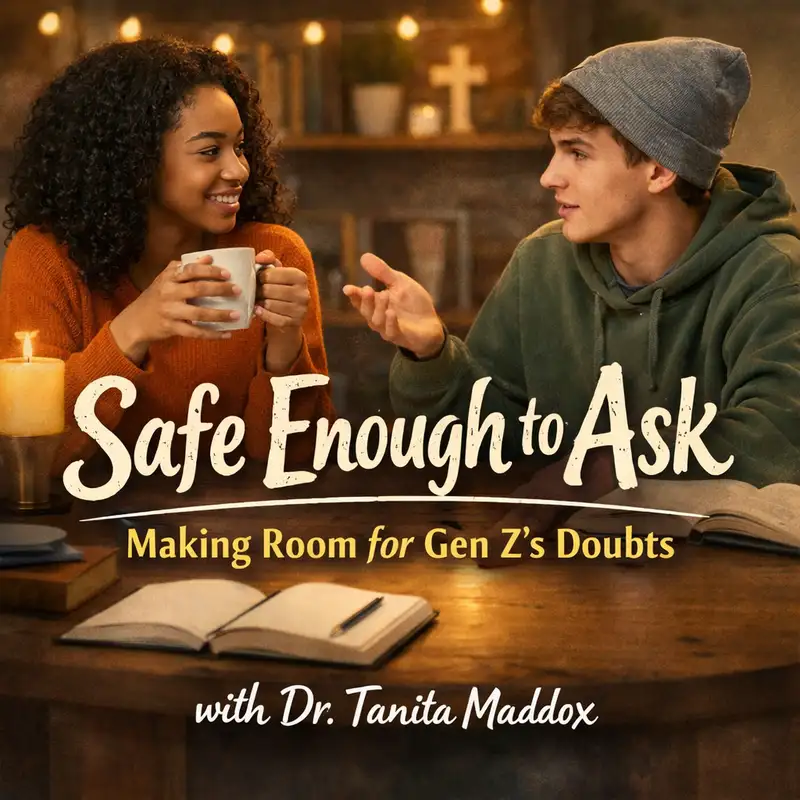
Safe Enough to Ask: Making Room for Gen Z’s Doubts
Hey, y'all. Welcome to spiritual not religious. This is a podcast for young adults that explores the intricacies of God's kingdom and the modern world.
Shawn:Hey, friends, and welcome in to another episode of spiritual, not religious. I'm your host, Shawn Winburn, and I'm joined by my cohost, the podcast pastor, James Henry, and the seminary sensation, Mollie June Miller Bachman. And we are truly excited and blessed that you are joining us, and we cannot say enough how much we appreciate you listening in, and we sincerely hope that you feel great about sharing this podcast with everyone in your circle of influence. And a little shout out goes to one of our faithful listeners, Thomas Young. Yep.
Shawn:Talking to you, my man, who has been making his way through our podcast and recently suggested I get a better microphone as it sounded as if I was speaking into an empty soup can. So can't wait till Thomas gets to the last few of our podcast to hear that I have indeed upgraded and hopefully sound a bit more tolerable than usual. Okay. We want all of our listeners to know that our heart's desire is to engage emerging and young adults about their questions regarding all things spiritual and religious and everyone else who invariably ends up thinking about God at some point in their lives and how that relates to them in a relevant way. Regardless of where you are in life, you are bound to have some questions about the church, about belief, and about what it all means.
Shawn:And we invite you to take a metaphorical walk with us in the woods of spiritual conversation that takes a journey into our own insights, questions, and hopefully, some good laughs. And in this episode of spiritual not religious, we are excited to be speaking with our guest, doctor Tanita Maddox, who is the national director for generational impact for young life and Gen z expert. And she is a veteran youth worker and sought after speaker and author. And today, we're going to be talking with, doctor Mattox about her latest book, What Gen Z Really Wants to Know About God, where she explores seven questions about life and faith of Gen Z ers. So doctor Mattox, it is so good to have you on Spiritual Night Religious with us to chat through some of your wisdom and discoveries you've written about concerning our Gen Z friends.
Tanita:How are having me. Oh, please call me Tanita, by the way. Call me Tanita.
Shawn:Okay. Alright. Tanita it is. And so, I I do wanna start because at the beginning, we were just kind of, chatting through a few things. We have to bring this, little thing you have behind you, this hot chocolate backpack.
Shawn:I I've never heard of this. I've never seen this. And this thing is a full blown, just incredible piece of workmanship. Look at that. Are you kidding me?
Shawn:It's How much does that hold?
Tanita:I I've gotten two gallons of it of hot chocolate in there, I think I can get it I think I can get a third. I don't know if I can carry three gallons of hot chocolate, but I think I can fit three gallons.
James:Three gallons would be about 25 pounds on your back, Tanita. That's a lot.
Tanita:Don't know if
Mollie:I can. Amazing.
Shawn:It's like the ghostbusters of hot chocolate. Like, this is incredible. I love that hose that's there. Just all of that. Where did you find it?
Shawn:Is that, like, on SkyMall or something? What where do you get that?
Tanita:I wish I could take credit for purchasing it. I think my boss actually purchased it a couple years ago. Found it, cleaned it out and yeah brought it over to the campus. It's really fun to greet high school students as they come out and say would you like some hot chocolate? And they say, where?
Tanita:And you say, right here. And you pull up a little Where else? Little nozzle. It's got a cup compartment. So you pull out the cup, put in the hot chocolate.
Mollie:That's amazing.
Tanita:It is. It makes everybody's day better.
Shawn:Love that. Well, my day just got better. And so thank you for sharing that. That is crazy. Well, let's begin with, how Gen Z became so important to you so much so that you felt compelled to write a book about them.
Shawn:Maybe tell us a little bit about your journey to this point.
Tanita:Well, like you said, I've been in youth ministry as an active young life leaders since 1998. And I would say around 2015, 2016, I really started to feel like things were not working anymore. Everything I've done for forever, all of a sudden it wasn't landing, it wasn't working. I was seeing a lot of anxiety in students and panic attacks and just some hostility even and not wanting to get together in groups. And my first thought was, Oh my goodness, it's me.
Tanita:I've gotten too old to do youth ministry. I was pushing 40, I'd become a recent mother and I immediately thought it was me. It was really starting to read a little bit and see that it wasn't me, it was that generational shift had happened that I'd been treating our Gen Zers like they were Millennials and didn't know that they were here. And so this project actually came out of my doctoral thesis of feeling like I am failing and I've to figure out what's going on. What better thing to study than how to share the gospel with the next generation of adolescents that we're with?
Tanita:And so took that and now I get to share it with everybody else also as I talk to people and say, Oh my goodness, we don't know what we're doing either.
Shawn:That is awesome. What a great journey. Yeah. And I can kinda relate to that too where you you feel like as a leader of, young adults and teenagers, oh, no. It's me.
Shawn:I'm I'm I'm I'm aging out of this, and they don't get me, and I don't get them kind of thing. But how special was it that you were able to realize, oh, wait, no, there's something else going on here. It's not about me. That's beautiful.
Tanita:Yeah. Turns out you're not too old to do youth ministry by
Shawn:the way. No. Not at all. Not at all. And some of my best, youth leaders were in their 60s and 70s.
Shawn:And so it it's true. Well, you write about seven questions in in your book that you have found that Gen Z seems to be asking. And I'm only gonna mention a few because I want our listeners to go and buy the book to read the rest of them. So you ask some of the questions that you ask are, is God good? Do all people matter to God?
Shawn:What is true are just a few of the questions. And and it makes me wonder if really all generations may have been inwardly asking these same questions and Gen Z has been able to articulate them and be bold enough to ask them. What you think about that?
Tanita:Yeah. So the questions in this book specifically are based on their experiences and worldview. Right? There's other questions on development. Right?
Tanita:We've three big questions by Kara Powell and Brad Griffin. They talk about three big questions. That's part of your development as an adolescent. These are based in values, experiences, worldview. Like you said, some of these questions are timeless.
Tanita:We actually hear Pilate ask what is truth. Right? Like, when he's, during Jesus' trials, these are not new questions. However, the context around the questions has changed, the environment in which these questions are being asked has changed. So while it's really tempting to hear the questions and say, Oh, I already dealt with that.
Tanita:I can answer. I know the answer to this question. We can risk actually giving the wrong answer because we're not hearing it through their lens. I'll give you a quick example just in real life.
James:Like I
Tanita:had a young woman come to my house and she asked me, do have anything to drink? Now, and then she started going through all my cupboards like rifling through all of my cupboards. And if you were like, what is she looking for? What's
Shawn:she doing?
Tanita:However, because I've known this young woman for a while, what she was looking for was if I had alcohol in the house. Her mom was an alcoholic. She'd often been tasked with sitting in a parking lot in a car parked outside of a bar until her mom was done drinking so she could drive her home afterwards and so when she came to my house, what she told me and she said in her words, I just want to know you're going be the same while I'm here. Do you have anything to drink? And so as she went through this coverage that's what she's looking for.
Tanita:If I didn't know why she was asking that question, I could have given her the wrong answer, missed completely what she was really asking about. And so that's kind of like what we talk about with these questions is know why it's coming out so you can give them the proper answer.
Shawn:Right, right. Not being symptomatic about it but really trying to get to the root of what's going on. I love that. I love that.
Mollie:When we talk about Gen Z and we talk about what is going on in their framework and the things that they're experiencing, in your book, in what ways do you think that anxiety and depression and mental health plays a role in these seven questions that you have?
Tanita:Well, I start the book with Is God Good? Really talking about this mental health space because if we are experiencing deep fear and anxiety and deep hopelessness and depression, isolation, loneliness, those are the things that are part of our lives. Honestly, for at least half of our Gen Zers, there's some level of this going on and for many it's multiple levels of this going on. It would be reasonable to look at God through that when you're looking through that lens going, do you do you even know what's going on here? Like how could what I'm feeling right now be good?
Tanita:How could I what I'm going through right now be good? And then at the same time because of their access to social media and online digital media they can see all suffering and violence around the world at the exact same time which also impacts their mental health. I mean the mental health thing is complicated. There's like 80 reasons why that these things are happening. Yes.
Tanita:But when all that's like on top of each other it'd be really easy to conclude that that God might not be great or I've heard one Gen Zer say, I'm not sure God is kind.
James:Well
Shawn:I've heard one say they don't believe God is good or kind. Like just straight up, nope, don't believe it. That was based on very real and personal hardships in their life. And so, yeah, I totally understand that. James, what do you got?
James:Well, one of the things I appreciate so much about your book, Tanita, is that you invite us to actually enter into a relationship. It's not just that a person asks a question and we give them the answer. It's not a shallow, well, this is the answer. It's tell me more about why you're asking that question. Where does that question come from?
James:Could you say more, how is it that perhaps Gen Z today sees the church as a less safe place to just accept the answer, to trust the answer from other adults? Are there some underlying things you could say about that?
Tanita:Well, it's layered, of course, right? And what you just were talking about is pain and pain is something that is can be a root of all these questions and pain is something that generally we're uncomfortable with so we try to like get rid of it as quickly as we can. And to your point of just saying this isn't about just answering a question and then moving on. Like my background is cultural apologetics. I love apologetics.
Tanita:However, apologetics doesn't necessarily solve pain. Being with someone solves pain, like not solves pain but at least acknowledges it and enters into it instead of trying to find an answer that is palatable. I am reading a book right now and I think this does a good job of addressing it. This just came out, Faithful Futures by Josh Packard and he talks about he's more of a sociologist than a theologian. He says it in his book, I'm a sociologist not a theologian.
Tanita:He says, we live in a very low trust culture right now but generally we're trying in the church is trying to use high trust systems to reach a low trust culture meaning things like we measure attendance. Well, attendance means you trust that place enough to be there and in person on a regular basis. Giving is something we measure. And that's a high trust thing. I trust you with giving my money.
Tanita:And so I think what we didn't what we're not recognizing is that there is an extremely low level of trust. If you're working with Gen Z, you're in youth ministry or college ministry, you're already feeling it because it's not showing up to the school with a flyer and bag of lollipops or whatever and like, see you tonight, nice to meet you. It is taking a couple years to earn trust of young people after being in their life on a regular basis and they're just kind of testing things. And so that's not the church's fault. It is the environment that the Gen Z has grown up with.
Tanita:It's not just the church, it's any authority figure, person in power, person with more years on them, any institution. They've been taught not to trust, that their trust is valuable, they're going to hold on to it first, let you prove that you are worthy of it and then give it away. And that's shocking for us who grew up with that adage respect your elders, trust the church and so we gave it away right away. And so it's really shocking not to receive it right away but there I mean there's a million layers of this but what we're talking about is a cross cultural intersection between our Gen Zers and the church and we don't recognize it as cross cultural so we don't understand why there's miscommunication or disconnect.
Shawn:I kind of want to follow-up a little bit on that distrust piece, because you talk a lot about the distrust that Gen Z has for faith based folks or Christians or Christianity in the chapter Do All People Matter to God? Mhmm. And you cite examples where Gen z distrusts a faith that was used to colonize and culturally assimilate other people groups, testimonies of physical and sexual abuse by faith leaders, how the Bible has been weaponized and used to defend social injustices like slavery, racism, sexism, and more. And you you bring up a really interesting dynamic in that. You say that Gen Z's values and moral standards stand against the practices committed by many in the Christian faith, and yet Gen Z's ethics are rooted in Christian teachings.
Shawn:Can you kinda walk us through what is happening here and how you see this, moving forward or being resolved?
Tanita:Oh, I love it. I feel like that being resolved part where you're like, I don't know. I've looked back on church history. I'm not sure we've resolved it quite.
Shawn:Right. I mean, you've got to have the answer. Right?
Tanita:Oh my goodness. Well, my good friend Sean Mcgeever came out with a book called Ownership last year, and the Evangelical Legacy in Slavery. And he starts his book really by saying, If any of us read this and we think I would never do the things in this, I would never be so basically dumb to do these things. He goes, You just put yourself in a position of thinking you were better than somebody else and that's the exact mindset that started this problem. You know, that's not an exact quote.
Tanita:He's very smart and it's very eloquently put in his in his book. But there but the to to to take it with humility is really helpful to know, like, oh my goodness, like, I I don't know how we solve it Mhmm. Because we are peep like, we are people who are flawed. We have we reflect the image of God, and we reflect a distorted image of God Mhmm. In our sin.
Tanita:I think we oh gosh this is really high level and I probably wouldn't even talk this because this is like we said this is a pain conversation for Gen Z and it takes a while to move past the pain to have a more, like, I don't know, not intellectual but drier conversation, probably informational conversation. Yeah. To look back and say, can we separate, some of the practices from what the intent of the scripture was. And also accept that in my lifetime I will also have had poor practice of doing what I thought was best and what I thought was good with what I had, and thank the Lord that his death and resurrection cover all of that. I think of even just I think of even being 19 year old freshmen in college and giving what we call our club talks in young life, Our gospel proclamation a middle school to middle school kids and I look back and go, oh my gosh I had so much heresy coming out my mouth.
Tanita:I had no idea what I was doing. Praise the Lord that he's in charge of all those things. So don't I know if I have a social answer to solve it except that I'm trying to in my own life figure out how to put those pieces together.
Shawn:Yeah. And it just seems like if if the church could come forward and in humility speak, hey. You know what? We got a lot of things wrong, folks, and you're right. I wonder if that might go a long way and maybe give some some credit towards gen z and, like, we get how you're feeling because you're right.
Shawn:Like, some of these things, these are inexcusable and they really don't have anything to do with the things that we believe. Mhmm. I feel like a lot of churches seem to want to double down on what it is that they hold so tightly to. And then we just kind of get into this little bit of a struggle between what Gen Z are trying to say and then of course what the church is portraying. And
James:so Yeah.
Tanita:Think it can start with just me. Yeah. I think it just starts with our individual saying, I don't have it. Like, I've made tons of mistakes. I didn't apologize today for the things you know, like I'm sorry I had a bad temper this morning or I'm sorry I was short with you, had nothing to do with you or you know I'm sorry I said that when I was hungry or whatever you know it is.
Tanita:We the more we say we're sorry the more we reflect at least acknowledgement that we're in the wrong wrong spot. And the mystery of it all is I had a class with Doctor. Zach Eswine who wrote Imperfect Pastor and Preaching Christ in a Post Christian World and what I appreciate about him, I mean he would say the things he disagreed with like, I agree with this author, I agree with this theologian, but then he would pause and go, but we're gonna be in heaven together for eternity. So I guess we'll have to figure out at some point, you know? I really appreciated the humility of, I don't agree with this person, but we both are covered with the same promise in Jesus Christ.
Tanita:And that's where it gets real uncomfortable is when you start to look back and go, but does the death and resurrection cover that also? Like, start to make real big guesses about, what redemption is, and that's when it gets really uncomfortable in the conversation.
Shawn:Oh, boy. Absolutely. That sounds fun.
Tanita:I'm uncomfortable right now, you guys. How
James:do you think the best way we can make room at the table for all the different voices? I guess my question really boils down to sometimes it seems to me the church confuses being right with being loved. And we miss out on the chance. When I look at the gospel, I see Jesus always erring on the side of being loving rather than being in what everyone else's interpretation of the rules were. And I even say, I have said to my congregation several times, God broke the commandments.
James:I mean, he said make no images and then there's Jesus.
Tanita:Know. That's interpretation of that.
James:I said there's no images, but I'm gonna make one.
Tanita:Jesus and people can't make images.
James:You shall have no other images.
Tanita:It was a whole other conversation. But I
James:mean, the truth is how do we air on the side of being loving like it would appear to me Jesus' actions were? How do we air on the side of being loving and not really trying to be right? Because you have to start somewhere in a conversation. And if I start with, you're my project, and I want to convert you to my way of thinking, which is the by the way, correct or orthodox way. Many people are there in the world with an orthodox way of seeing the world because it's their way and their way or the highway kind of thing.
James:But how do we start? I mean, can we make room at the table for people whose idea of who Jesus is so I saw a recent a person I thought I really trusted in faith had a meme with Jesus carrying a submachine gun. And this is what Jesus would do. Not the Jesus I read in the gospel. I can't even begin to stretch Jesus that far, Maybe, but that's how do we find a way to have a conversation that's trustworthy when someone's conversations with other Christians throughout their lives had said, is it.
James:You do it my way, it's immersion baptism only. That's the only thing God is willing to do without even knowing what all of the words behind it are. And we're regurgitating things we've heard as opposed to what may be true I guess. How do we make that room?
Tanita:First of all your algorithm is wild that you got that meme like that's wild. I got St. Nicholas punching Arius at Council of Nicea this week as a meme in mine, so I don't know what's happening with that.
Shawn:I definitely need to
Tanita:see that. Think that
James:there is at least a, you know, a story about that happening.
Tanita:Yes, there is a legend. There is.
James:But it's legend. I mean, and, you know.
Tanita:I would love to believe it though, because this is off topic. We were watching the Santa Claus with our kids you know the Tim Allen character goes like Santa would punch someone and actually my husband looks at me he goes well. Anyway, maybe. Think part of it goes back to the humility place I think for all of us. Think that I'll find out everything I was right and wrong about in my theology about five seconds after my last breath, right?
Tanita:Like as soon as we're on the other side of heaven we go, Oh my god, that's right or wrong. I love being a part of an organization like Young Life because on my own team we come from a handful of different traditions and so we disagree on things that are important. We wouldn't call them salvation issues, but they're
Shawn:important
Tanita:to us. But we can almost joke about it because it's like, well, we'll be together forever so at some point we'll figure it out. Think there's a little bit of getting to say I don't know. This is the best I got. We all have the same bible in front of us.
Tanita:We're doing the best we can with what we have. But the biggest piece that we see in our research on Gen Z is they just don't feel like churches or Christians or any kind of institution of faith is open to their doubts or questions. That's the biggest piece. So if we make room for doubts and questions, they'll test us out. They'll poke little things in here and there and then see how we respond to that.
Tanita:And if if we respond in a way that allows them to feel like, oh okay, so they are serious. Like I am I can bring my questions here, they'll bring more questions there. But I think every time I speak I start with that, know, hey what questions do you all have or what questions do people your age have? Or do the kids at your school have? Because it's a little bit less direct.
Tanita:And then open the floor, and you can watch all the adults just clench like, gosh. Why why did you do that? You know? Just open
Shawn:it up.
Tanita:Just open it up. And I'm like, I'm not promising to answer them. Just want to hear what they have to say. It's amazing how many people will share if you just say, just would like to know what you're thinking.
James:Perhaps one of the biggest challenges is that we feel as adults that we have to have an answer to every question.
Mollie:Absolutely.
James:And I do think that sometimes the answer is, you know, I don't know the answer to that question. Twenty years ago, I was sure I knew the answer to that question. And growth and God have changed that perspective altogether.
Tanita:Well, think that's one of the biggest mistakes I'd made ministry. If I could go back in time, I really did a lot of Bible studies and know club talks that were easy to wrap up with a bow and really avoided a lot of the passages that you have to wrestle with or that people still don't know what they mean. And I really taught to the young people that you should have all the answers, everything. You can figure out everything in the Bible. It's that easy.
Tanita:Instead of being able to go through and have be able to say, okay, you don't like what you read or you don't understand it or you're frustrated, can you follow a God that you don't understand or agree with all the time? Because that's actually what it means to be a follower of God.
Shawn:That's strong.
Mollie:Absolutely. Tanita, you you mentioned in I think you were answering Sean's question, and you mentioned that we reflect a distorted image of god. Can you expand upon that? Because I love the way that you put that.
Tanita:I don't know, my dear. Are you asking me to talk about snakes?
James:Being right expert.
Shawn:TJ, been so good for you on the show. We appreciate that event. Next week.
Tanita:I mean, are you saying in in, in comparison to talking about total total depravity versus distortion? Or what are you asking as far as
Mollie:When you said the phrase, like Yes. We reflect a distorted image of God.
Tanita:Like, what
Mollie:does that mean to you?
Tanita:Oh okay, yes. Mean that we, right, we bear all humans bear the image of God. Like that is that's a non negotiable in it, right?
James:Genesis one twenty six.
Tanita:Yeah, so So we all reflect the image of God. However, we don't reflect like a mirror, well assuming you have a perfect mirror, we don't reflect it perfectly into the world. We are a fallen, I don't know
Shawn:to call
Tanita:it, like a fallen part of creation, fallen creation, we have sin. So that reflection is not clear. It's distorted. It's mixed up and not necessarily should someone look at me and see a clear picture of God. They're going to see pieces of Him hopefully and then, that needs to be separated from the way that my sin, and the parts of me that are still being in the process of being sanctified and molded and made more like Him are gonna reflect distorted images.
Tanita:Is that good? Is that right? Yes.
Mollie:Thank you so much. I appreciate that.
Shawn:Well, we've been a lot of fun with Tanita Maddox, author of what gen z really wants to know about god, And we're gonna take a few minutes to step away, but don't go away. We'll be right back with more questions and more fun. Alright. Welcome back friends to Spiritual Not Religious. And we are with our guest, Doctor.
Shawn:Tanina Maddox, who we are so grateful to be on this podcast with us, talking about our good friends, Generation Z, and her book What Gen Z Really Wants to Know About God. And we've just been having fun peppering Tanita with all of these great questions, and we're going to continue to do so for the next twenty five minutes. So hang in there with us. Also if you have some questions that you would like to ask Doctor. Mattox, please send those in and we'll tell you how to do that at the end of this show.
Shawn:But Doctor. Mattox, I want to continue asking you some things about things that you had written in the book. You say that a reason that Gen Z claims to be spiritual not religious is a generational disconnect. Where each generation is saying things from a different perspective. And you use the illustration of the prodigal son.
Shawn:And you say in that story Generation Z is focusing on community and charity in the story, while older believers are focused on personal stewardship and responsibility. And that's gonna be on page seven friends, when you buy the book and read it. You say that here is where being able to contextualize the Gospel becomes very important. And can you kind of walk us through that a little bit? Tell us what you mean by contextualizing the gospel and how this helps everyone involved.
Tanita:Yeah. Well, part of this comes out of, some of the research saying that the gospel, that church the church or churches, are valuing and sharing is not the same gospel and faith that's important to Gen Z. So the big question then starts with are you saying there's more than one gospel and faith? No, no, no. Not saying that.
Tanita:We're saying it's so broad though. It's it's so broad, and deep. Like, there's so much in it that any presentation we do of the gospel is contextualized. There there is no such thing as a non contextualized sharing of the gospel. If If you just read, even just reading the Bible, even just you know just taking even the four gospels, everything is contextualized for an audience that is being shared with.
Tanita:That's why specific stories and specific references are used for specific audiences It's to take the mystery of God and then try to explain it in a cultural setting to an audience in a way that makes sense to them. So it's always been contextualized. The mistake that we often make is we repeat what was contextualized for us for a culture that is not ours. So whenever we do that, we take, hey, this made sense to me. It was contextualized for me.
Tanita:I understand it this way and I'm just going to repeat it wherever I am, whether that is, you know, geographical country, like culture, like crossing those boundaries or generational. It doesn't always translate, because you're now you're using a message that was designed for a specific point of time in a specific audience and then assuming it's going to resonate.
Shawn:Translate right on into the next one.
Tanita:Yeah. Exactly. Mhmm. So Mhmm. Really, this has been an opportunity for me to, like, pull back and zoom back and go, k.
Tanita:How do I what where are all these pieces of the gospel of creation, incarnation, of atonement, of all these pieces where we've really narrowed it down to one little point. We can usually say things in one quick sentence to somebody. That's the contextualization right there and realize it's just narrowing down to one point. It's actually missing a lot of things that are still true and a part of that, but we're trying to get our point across to a way that understands for one person. So that's where that kind of disconnect comes.
Tanita:It's It's a generational disconnect. It's ultimately a cross cultural disconnect.
James:Yeah. Yeah. I remember, I have to say that you know, I can't tell you how many times I've preached the Good Samaritan. I mean, it's a good place to go. But the fact that you brought out that in your conversation that what the focus was, was part of the reason why he came home was because no one would give him any food.
James:It wasn't just that he realized he was wrong. It was that nobody was helping him out in the rest of the world. The rest of the world was untrustworthy. Had never noticed that, Tanita. I felt like, oh my gosh, all these years I've been reading this stinking story.
James:It's amazing story. And so I want to tell you that if I got nothing else out of your book, and by the way, I got a lot of things out of your book. That one was just a piece of, you know, the I think we stopped asking some of our most childish questions, ours, you know, because the answers we got when I was growing up in Sunday school every Sunday, it was one answer. Here it is. This is what it is.
James:And I just you need to unpack those tapes that are playing in your brain. And I was like, my God, this has blown open my whole mind. I can never preach the Good Samaritan again the same way.
Tanita:Is I mean we could get crazier too because there was also a famine, right? So if you're talking to a young person who's been a victim of a lot of things in their life where they're like, I just don't understand, you know, like I didn't do anything wrong. And you're like, Yeah, there was a famine. There was no food. Right?
Tanita:There's a combination of factors that are going on here. So even someone who maybe isn't struggling with the personal responsibility piece or the community wouldn't give me food, it's just like there was a famine. You were alive during a famine. There was no food to be given to you. So there's a lot of layers and that's why I love, that's why, oh my gosh, I just love the scriptures because they get so deep.
Tanita:But to your point, can zoom in on any point, and miss the other ones that maybe our young people are looking for.
James:It's never just one thing, is it, Tanita? I mean, you know, I want it to be one thing. And this week when I'm reading the scripture, it is that one thing. Then, you know, it's like, how did I miss that? Thank goodness I haven't recently preached the Good Samaritan.
James:I have time for redemption, provided I live long enough and preach it again at some point. Thank you, Tanita.
Mollie:Tanita, I love the way that you talked about contextualizing the Bible and how easy it is for people to just be like, oh, well, this is what I've been told. Let me regurgitate what that is. How do we help not do that for young people when it comes to, like, their questions? So if someone has a question and I feel like, oh, well, this is what I've been told. I believe this is the answer, and I share it with them.
Mollie:How do I make sure that I'm not just contextualizing it and just stating what I've been told?
Tanita:I mean we're probably all doing that all the time. It's just, you know, part of like us. Right? We're trying to sift through our own cultural context. We're trying to like sift their cultural context, and then we're trying to understand the mysteries of God in both of those contexts.
Tanita:So it's going to be messy no matter what. At the very least, it's really doing our best to listen to the prompts of the Holy Spirit. Probably being quiet more than I should, like more than I speak, right? Like I should be more quiet than I actually am because letting someone share and process more helps me really hear from them and then also gives me time to listen to the Holy Spirit. In it, you don't have to be a trained theologian right to do this like, to go, oh, I know all these know all these atonement theories or whatever it is like I can share one.
Tanita:But to really just listen Lord and just go, Lord what does that person need to hear from you right now? Like what do they need to know about who you are right now? And many times it's actually surprising that the question people start with when they sit down and talk is not necessarily the question they're really asking or the question they end up with. Right? Absolutely.
Tanita:Right. You start finding out about a lot of all the things that are going on that led to that that moment. Yeah. And sometimes the answer is you just sitting there and listening to them and that's just they just didn't know that they could do that and that's a picture of who God is when we listen to him. So it's really hard.
Tanita:I would say that's a learned process more to be practiced at. Okay. What's what's good news for me? What's good news for them? Yeah.
Tanita:And and processing all that. I think it's just being slow to speak. Don't assume that you know what the answer is right away.
Shawn:We can't preach that enough slow to speak. My goodness. We just feel like we have to have those instant answers, those Christian cliches and oh my gosh, if we could just sit and be and listen. What a difference that would make.
James:Don't you think part of that though is our own insecurities? I mean, we have built one of my seminary professors, a brilliant man who broke open my theology, you know, talked about how we build a house of cards of the things we think are so important to theology. And you know, if any one of those one cards disappears, the whole house collapses. And we're not even necessarily building it on what you know, scriptural witness may be or anything else. This is what we've heard.
James:This was what feels comfortable to us. So, if someone says something other than that, it leaves us in a place where we either have to say, wow, maybe there's more ways to see this than one.
Mollie:Absolutely.
Shawn:Or Humility.
James:You're wrong. And I think being able to go somewhere in between, is something I just don't think we're very it takes a big adult to say, and I don't know that we help adults be vulnerable with their and it's a vulnerability to say, my way doesn't have to be the only way. Maybe my way of understanding I mean, just like you blew my mind and my heart with the Good Samaritan. And initially I wanted
Shawn:to push back and I was like, there's no pushing back.
James:Absolutely true. But I think sometimes we're reactive and not responsive, which is a whole different thing. We get triggered. Well, this is what I've held onto my whole life. It's important.
James:You got to believe that.
Tanita:Think I've never won any arguments by telling someone that they're wrong or I don't think I've ever led anyone to Jesus by saying telling them that they're wrong either.
Shawn:Oh they're going to hell.
Tanita:Like you said, it's a quiet confidence. Like I am assured in my faith. I know what I believe and I'm confident in the Lord Jesus Christ. But I'm confident enough that I can sit and take what's happening across the table from me. Unless they're asking for what I think, sometimes it's not always helpful until they open the door and say, what do you think?
Shawn:Or because
Tanita:most of the time they're asking us to listen to their story and I'm trying to listen to the Holy Spirit going, where is God intersecting with their story?
Mollie:Yeah. Tanita, what I hear you saying in that and what I really appreciate is being in college ministry, like, that is what the next generation, like, you're talking about is, like, craving so deeply. And I think the way that the church is moving and should be moving is in those in between places where I can listen to you and think something differently, but what is god saying about this situation, not what humans are saying about this situation. And I really wanted to echo that because I appreciated that perspective.
Tanita:Oh, praise god.
Shawn:I love that. In chapter four, you talk about the difference between following the letter of the law and the heart of the law. And I'm gonna read a little quote here that you had. You say, I am so grateful for generation z and their eyes and hearts for others. Their value of acceptance is a gift to this world and a gift to the church.
Shawn:Gen z pushes our older generations to wrestle with the letter of the law and the heart of the law. And in discipleship, we get to work together to figure out how to be a neighbor, each generation helping another. And we can thank them for their partnership in this, end quote. I love that, by the way. Sometimes trying to plug into a faith community feels like there is a well, you must change first before you're welcomed kind of mentality.
Shawn:So tell us how you see getting folks to follow the heart of the law helps this generation to be more open to conversations about faith in God.
Tanita:Oh, you know it's so interesting, I just wrote this article today and there's something called the five three one rule. Have you guys heard this or the one, three, five rule? It's like a new trend right now on what they call social fitness as far as like you're supposed to have five social interactions a day, three deeper conversations a month and oh, man. 531. 53.
Tanita:What's the one? I there's another like one other something per week. It's like it's like I I can tell I'm really familiar with it. Anyways, what was interesting about it is as you start to process that, you go, well, how do I know what's a what's a deep interaction and what's a social interaction? And and you start to go down the rule of like all the definitions of these rules.
Tanita:Am I doing it right? You know, if I if I have a ten minute conversation with Molly but we connected on something pretty significant, like we went straight into it, we shared deeply, we even cried together and then we said, Hey, gotta go. I gotta jump on the Zoom call. Is that a deep connection? You know, and you start to understand why the Pharisees were wrestling with how to define all these things because they want to do it right.
Tanita:Like you want to do it. I want to do it right. Yes. It's even just like this writing this article and trying to understand this rule going, how do you do it right? Is is all is like in there, you know, on there.
Tanita:I'm going, want to do it right. And sometimes wanting to do it right, we miss what's the purpose of it? What's the heart of it? I want to do it right but what was the heart of it? And going back to those places.
Tanita:We talked about earlier like you could be right or you can be loving or sometimes, you know, say to my kids actually, like you can be right or you can have a friend. Which one do you want? So
Shawn:Yeah. No.
Tanita:That's a
Shawn:great point because I think a lot of people would choose, well, I'm gonna be right.
Tanita:Mhmm. Yeah. You can be. Fortunately. Or you can have this friend.
Tanita:Which one? Right. Which one do you think?
Shawn:Which one is more biblical, right? Yes. And I feel like you see that play out more biblically with particularly with Jesus, but go ahead, I'm sorry.
Tanita:Oh no, that's it. So we're just in another moment as culture moves, as society moves, as different things in the world move of going, okay, how do we recontextualize what the heart of this is to be interpreted and practiced and executed in today's setting.
Shawn:Yeah, exactly, exactly.
James:Timeless gospel the time we live.
Tanita:Yeah, God's not, He's outside of our culture but He interacts us with us within our culture. I think Gen Z is pushing us to figure those things out and I do appreciate that about them. They're asking very good questions about how our faith impacts how we live our life and how we interact with the world and how we impact our communities in a way that hard and good.
Shawn:That's awesome.
James:I actually wanna take Matthew 25 seriously. I just, you know, I come on.
Shawn:Please someone take it seriously. I love it. So James, we'll let you ask a question. Molly, you ask a question and then we'll kind of close things out here.
James:Wow. I had so many questions in the beginning and now I feel like I'm in one of the big issues that you raise, and I think is a bit you said is the top need of Gen Z is safety. And part of that was driven home by the fact that their parents discovered, hey, we weren't safe. So then we just like drove home this message of safe, don't trust adults, don't trust, don't trust what are some I think you talk about it in the book in lots of ways that we have to listen first, we take time. We've talked about it in some ways.
James:But how can we help both dispel the myth of safety because there's nothing apart from God. There is nothing in this world that is completely safe. And for young adults, I think, you know, for Gen Z, I'm not sure they think God is safe. And the truth is, I actually now that I think about God is not safe because God is constantly asking me
Shawn:CS Lewis.
James:Okay. How back around. Sorry. As I asked a question, tell us talk could you talk a little bit more about safety? Because I do think if it's a need, how can we help recognizing ourselves that safety it's you know, it's only it's a fleeting thing at best, if it's even a thing.
James:How do we do that? How do we do that in the church and in community and as adults?
Tanita:I mean, just yesterday there was a commercial that came on TV while we were watching a Christmas movie and it was for the Skechers. It has a kid's shoe that you can put an air tag into this it's got a special compartment you can put air tag in the shoe and it's the commercial was saying so now you can know where your kid's shoes are all the time and my 10 year old who's pretty savvy he's like that's about knowing where your kid is all the time. And I was like, it 100% is. It's 100% for parents to track where their kid
Shawn:is all. He's smarter than a 10 year old. Come on, Spencer.
Tanita:But that was that idea, right? Like, feel safe if I can track my kid, if I can see them wherever they are all the time. So we have to work under the understanding that the definition of safety is extremely, extremely broad in the sense that it can encompass a lot of things, but that it's individualized. Each person has their own definition of what it means to feel safe or be safe or what would make a certain environment safe for different activities or relationships and those kinds of things. So first of all, our young people are very comfortable using the term safety.
Tanita:So if you said, hey, what would make this a safe conversation for you? They probably can answer that question. What would make this activity safe for you? They probably could answer that too. They can give you those words.
Tanita:So that helps us actually understand where they're coming from. Now if we say, hey, how would you just define safety period? Most of our young people and really our larger culture probably is saying to always be successful, never be uncomfortable, to be happy, to never fail. That would be a safe place. And you click, okay, is that where does that definition come from?
Tanita:Like, is that a reality? If safe is if being safe or if safety, the idea of safety is good and God is good, that means God has a definition of safety that's good. It may not be our definition of safety. Right? Because it doesn't take very quickly in the Bible to be like, there's crazy things happening here.
Tanita:It seems like there's actually nothing safe about this.
James:Very risky.
Tanita:What is safe about God? Oh, that he accepts all that come to him. You know, I believe in the preservation or the perseverance of the saints that once I had you've given your life to him that he you belong to him forever, that nothing separates our love his love from us. Like these are good things that make me that are qualities I think of safety. Now does it always mean being out of physical danger, being uncomfortable or never suffering?
Tanita:No, that's not part of the deal. That's not part of God's definition of safety. Does it mean you're alone? No. Jesus was on a cross next to people, who were also dying on the cross.
Tanita:Like that seems unsafe. He was right there next to them. So we have to really wrestle with this idea of what's your context? What's your idea? How did you define safety?
Tanita:And does that match God's idea of safety, his definition of safety? Where do this come in conflict with one another? And that's where it becomes a really fun and vibrant conversation. Those are the places where I think my faith grows as an adult, and I see the faith grow of our young people as they wrestle with that.
Mollie:Mhmm. I love that.
Shawn:Me too.
Mollie:Tanita, I would like to ask if you were to say something to a Gen Zer who's going to a church or a Christian community of some kind for the first time in their life, what advice would you give them?
Tanita:I would say, look someone in the eyes and learn their name and learn one thing about them. And part of it is because, I want them to feel like they have, like, agency in the situation. You know, don't be passive and expect people to know exactly what you need or let them control your comfort. You are you walk in and you have the agency. So look them in the eyes, learn their name and something about them.
Tanita:Part of this also gets their brain focused outside of them. So sometimes it's in some different studies, you know, around anxiety, it can say, hey, doing something like this actually helps you take your brain off of yourself and puts it outwards. You're not as inward focused on those things. That connection of I'm going to listen to somebody. So you have to listen and pay attention to them.
Tanita:And if they're feeling good, they're if they I said if you want to go one step forward further I would say ask can I sit with you and then and then go and then go from there? So those that's probably what I would tell them is Uh-huh. What do you what do all think about that? No one's ever asked me that question. That was a good one.
Mollie:Oh, thank you. I love that you said don't let them control your comfort. Like, don't let others control your comfort. I think that is really profound to me. Something I'll be meditating on now.
Mollie:So I appreciate that. Thank you.
James:I appreciate that you encourage in a gentle way getting a little bit out maybe it's not outside the safe zone, but it's risky. I mean, that's the problem I have with the idea of safety is it's so risk averse. And everything about life and faith is really risking we're taking a risk that it's all true. We're essentially betting the whole thing on it being true. But I appreciate you inviting them to take what I would you know, that are small risks.
James:Look somebody in the eye, learn their name. Take the risk of asking if you can sit with them. Heck, it may be another person who's unwilling to risk and say, no, you can't. I don't know you. And then you've got to reeducate the congregation.
James:I mean, that's really a mess. That's a whole another podcast
Tanita:perhaps.
James:I appreciated that very much, Anita, the invitation to take what are because if you take small risks and they pay off, you can take bigger risks.
Tanita:Yeah. But you can also process with them because well, what if they say no? Okay, so what if they do say no? Like in a lot of what happened with those closures with the 2020 closures is we deleted or we delayed experiences at certain time periods in people's development where they learned some of these little risk taking materials or they learned how to actually problem solve through failures and setbacks and obstacles in age appropriate ways. Then now the stakes just got a lot higher as adults when you didn't learn it when you were 14.
Tanita:And so getting to actually process of going, well, what if they say no? How would you feel? What would you need to do? Do you need to take a breath? Do you need to go walk?
Tanita:Do you go wash your hands in the bathroom? What do need to do to try again? Do you need to go home at that point? Like, did you is that your big thing? Is you're like, I talked to someone, they said no.
Tanita:They laughed and you're like, no. But you talked this to someone, so that was a win that you did that. Yep. Yep. You get to problem solve things that maybe had been more automatic for previous generations but because we deleted a couple years of development, developmental experiences, we are still working through that with our young people.
Mollie:Absolutely. Thank you.
Shawn:Yeah. Tania, we're gonna give you the last word here. And what would you want to say most to our friends, our generation Z friends who say that they are spiritual, not religious based on the work you've been doing? What would be something you wanna get out there and make sure you talk about?
Tanita:I mean, those are such broad terms. I had, like, a thousand questions for that person. Right? Like, what do you mean by that? Like, where do you, like the things.
Tanita:Right? So many 100%. Yeah. Tell me your journey about how you got here. Like, what are the things you agree with?
Tanita:What are things you don't agree with? What are things you're wrestling with? You know, I have a thousand questions. I think, what would I wanna say?
Shawn:Point, isn't it? You have a thousand questions.
Tanita:Not Yeah.
Shawn:Just a blank face or, well, I know it all, so I don't need to really get to know you, or I've already made my assumption about who you are based by based on how you look, what you're saying, you know? But you're just saying that you have a thousand questions. Okay. I'm sorry. I didn't mean to interrupt.
Shawn:Just wanted to point that out.
Tanita:I would say, what would I say? I would probably say God, it can handle all of our things. Don't hold He's He's big enough and he's pretty patient. So you can take your time with with wrestling with all the things with him. You're never gonna have all the answers.
Tanita:It's just gonna be at some point do you know enough about him to want to spend your life with him? Just you know I use marriage sometimes as a as an example of that even though that's a horrible like horrible example right because that's like marriages end and you know that's two imperfect people like joining together and we're but we're not talking about that. We're talking about a perfect God with us. I can say, oh my gosh, this is like get weepy. Following Jesus Christ has changed everything in my life and I wouldn't trade one day for the journey that I've been on.
Tanita:And I can always say that on this side of things. But that's all I can tell you.
Shawn:Right, your testimony, No one can take that from you or refute that. And I love that, that's beautiful.
Tanita:Thank you.
Shawn:100%.
Tanita:Can't see
James:you guys anymore.
Shawn:Agree with that by the way.
James:In the end that's all we've got.
Shawn:Yeah. In the end that's really all we've got. Wouldn't do
James:it again another way.
Shawn:Tanita, how can people find you, your work? Where where can they get your book? Tell us all the good stuff.
Tanita:Well you could find my book on Amazon really easily what Gen Z really wants to know about God. You can communicate with me through my website, taneidamaddox.com. You can message me through there or even book a zoom with me there Or you can even message me on social media on Instagram at doctor Tanita Mattox.
Shawn:Brilliant. James, Molly, do you have any closing thoughts or or words?
James:No. Molly, go first.
Mollie:I'm just really grateful that you were willing to be vulnerable and share and, let us know a little bit about your heart. So I really appreciate that. And maybe I'll be scheduling a Zoom to talk more.
Tanita:I love it.
James:I really appreciate, I think that your courage and vulnerability showed in the way that you wrote the book. You shared your faith, you laid it out there. And then when it really came down to it, when Sean gave you that moment to say, the bottom line is my life was I feel exactly the way you do. Not if no two people feel the same, but setting that aside, I feel given a choice to do it all over again, yes, I would definitely say yes. I'm so thankful that I didn't know what would exist between the time I said yes and getting to where I am right now.
James:Because I might have thought I couldn't I was a smaller person. I'm not sure I thought I was big enough to make it through what the challenges that have been intervening. But God has always been faithful. And even when I couldn't see the faithfulness, when I didn't feel that, you know, that was more about me than it was about God. And I appreciate that.
James:So thanks for so much for being with us today and putting up with our antics. We do wander a bit sometimes. And by we, I mean me. That was the
Tanita:Sorry. Brought up Tim Allen. So let's just talk like I brought up Tim Allen. Yeah.
Shawn:Yeah. We're all in on this.
Mollie:And a hot chocolate backpack.
Tanita:And the hot chocolate backpack.
James:Wow. My life has been changed if nothing else but by this chocolate. I've gotta go find a hot chocolate. In fact, I wanted to search Amazon right while I was talking to y'all. That was my Samia,
Shawn:tell us how to find the hot chocolate backpack in Visual Ebook. And if you order now, you get a free hot chocolate.
Tanita:Rocket man. You gotta go to rocket man. Yes. Okay. And that's one
Shawn:of my favorite that's a cult Disney classic. Rocket man people, go check that out. Okay. Molly June, why don't you tell us how to, how our listeners can respond to today's podcast and how they can maybe order some of our stuff?
Mollie:Absolutely. So if you wanna follow us on Instagram, you can follow us at spiritual dot naught underscore religious podcast. And in our bio there, we have a link that you can purchase some of our merchandise if you'd like to. And if you want to send us an email, that is going to be at spiritualnotreligiouspodcast@gmail.com.
Shawn:Awesome. Thank you so much. And thank you all to, for being a part of this episode, and we look forward to hearing from you. And please reach out to, doctor Maddox, as well as go ahead and, order her book right away, and start reading through it. And, we look forward to seeing you at our next podcast.
Shawn:And in the meantime, know that you are loved, and Merry Christmas.
Creators and Guests