Thankful for Doubt: When Questions Deepen Faith
Hey, y'all. Welcome to spiritual not religious. This is a podcast for young adults that explores
Mollie:the intricacies of God's kingdom and the modern world.
Shawn:Hey, friends, and welcome back to another episode of spiritual, not religious. I'm your host, Sean Winburn, and I'm joined by my cohost, the truly exceptional James Henry, and the utterly sensational Molly June Miller Bachman. And we are truly excited and blessed. You are here joining us, and we want to say how much we appreciate you listening in and hope that you feel great about sharing this podcast with everyone in your orbit. A little shout out goes to one of our faithful listeners and my friend, or our friend, Julia McGee, who who had the wonderful there it is.
Shawn:Right there, Julia. See, we love you. We love you on this podcast. I had the wonderful opportunity to reconnect with her at a wedding I recently officiated. And Julia, it was great seeing you, and all the best to you as you start the next chapter of your life in Texas with your sister.
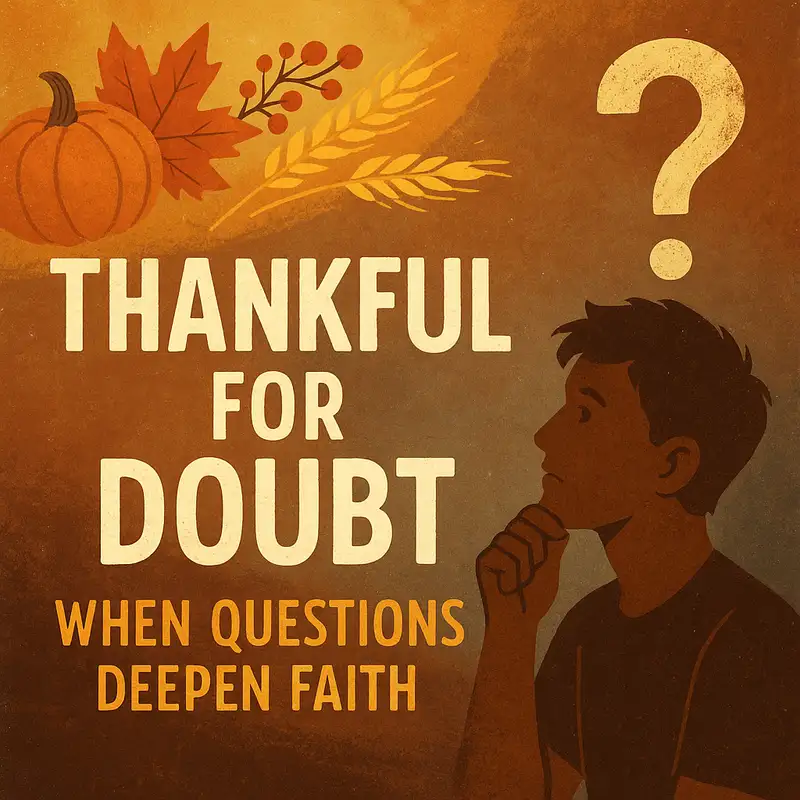
Shawn:And so much love your way. We want all of our listeners to know that our heart's desire is to engage emerging and young adults about their questions regarding all things spiritual and religious, and everyone else who ends up thinking about the economy of God's nature and way of doing things, and how that relates in a modern world of multicultural and pluralistic ideas. Now whether you're still in the middle or whether you're still in middle school or high school or you find yourself in college or maybe you're starting a family or a job or both, or you're in full blown retirement and you have some questions about the church, about belief, about morality, we invite you to take a metaphorical walk with us in the woods of spiritual conversation that takes a journey into our own insights, questions, and hopefully some good laughs. Now in this episode of Spiritual Nigh Religious, we wanna be mindful of this week of thanksgiving and give thanks for a few things going on around the podcast. So for example, we give thanks for you, our amazing listeners who have faithfully tuned in from all over the place and have given us some great feedback and even hope to keep doing the next podcast.
Shawn:And we give thanks for the fact that Molly and James haven't voted me off the podcast and continue to be the lovable and extremely tolerant hosts that they are. And finally, we give thanks for the topic of this podcast, which is being grateful for the doubts shared and questions asked about God and the church that lead us to wrestle with deeper faith and belief. Now, I doubt that you won't like this podcast, but you can question me about it later. Okay. Thanks for that.
Shawn:That was really polite. Oh, Lord. So James and Molly, here we are on the precipice of Thanksgiving twenty twenty five. And I think our listeners would be so thankful if I never offered another bad pun or dad joke again. So Molly, why don't you kick us off and tell us how you're doing and what you're doing for Thanksgiving this week?
Mollie:Yeah. Hey, friends. So I am doing pretty well. I like I said in our last podcast, I just started seminary this semester. And so things are kinda crazy in my world, but it's gone really well.
Mollie:And I've loved getting to know more and being able to share that in this space has been really cool. For Thanksgiving this year, I am going to my husband's, family. They're in Mount Juliet, Tennessee, so that's about three hours from where we are in Martin. And we will be going there, for the night and hanging out with them and seeing our niece and nephew, and we're we're really excited to be there. What about you, James?
James:This is the most quiet Thanksgiving we have had in many, many years. The last few years we have gone down to be with my we live closer to Linda's family, so we see them more regularly. So we have made it, since it's a further sojourn, by a couple of hours to see my family, we have made it to go down there. And dad died earlier this year and mom is not in a place to host us right now. So she is going to my sister's house, which means that my wife, Linda, and I and our son, Joshua, are going to share a small Thanksgiving, just the three of us.
James:Anna and her new husband John, my daughter and new son-in-law will join us for Christmas this year. Last year they made it a Thanksgiving thing. This year it's going to be, they're going to Thanksgiving with his mom and us for Christmas. So it's a smaller, more laid back Thanksgiving where we have taken requests. And by we, that's the royal we.
James:Linda has taken requests for the delicious meal we would prefer for this. Although all of us are baking. So we're going to share a small intimate Thanksgiving right here.
Shawn:Nice.
James:Back to you.
Shawn:What are
James:you doing, Sean? You didn't tell us what you were doing for Thanksgiving.
Shawn:Goodness. Well, I'm really excited. We've got family coming into town. We're here in East Tennessee. So we're gonna have ourselves a little East Tennessee Thanksgiving by God.
Shawn:So we've got a lot of family coming in and they're all gonna crash at my family's at my mom and dad's house and we've got my wife's family is coming in some of those folks and so it's it's going be a nice big crowd and there's going to be a ton of food to be had and I just am looking forward to seeing a lot of family coming in and taking some time off. So it's gonna be good. I'm a turkey and cranberries kind of guy. That's that's my go to. Like together?
Shawn:Oh yeah, 100%. Okay. Yeah, yeah. So you slather on those cranberries and it's kind of white trash. I like it out of the can.
Shawn:Is that that's bad to say, isn't it? Like, some people, like,
James:make it fresh. It's the way it comes. Do you like it with cranberries in
Shawn:it? Or or
James:just the nice smooth jellied kind?
Shawn:Either one. Either one. I prefer with the cranberries, but I do I like it out of the can. And, and they had that
James:goes off. Ridges still on it.
Shawn:Yeah. 100%.
Mollie:Ridges. That'll do it. Mhmm. We're having Friendsgiving tonight at our Wesley, and so I ate a turkey That's good. First time I have created or first time I had to pull the neck out of a turkey and make it, and it was insane.
Shawn:Oh, turkey neck.
Mollie:Yes. It was very wild.
James:It is. It went maybe it once was before it be got onto your table.
Mollie:Probably. My students Yeah. Love
Shawn:No, it's good. I always love talking to people about what they look forward to most on the dinner table for Thanksgiving. And you do you get a lot of different responses. Turkey neck is a first.
Mollie:Well, you don't eat the turkey neck. You pull the turkey neck out of the inside.
James:To make the giblets. Right? Eat the turkey neck.
Mollie:Yeah. But I don't do that for I throw them away.
Shawn:Oh, no. No. No. You gotta make giblet gravy with that.
Mollie:No. No. No. No. No.
Mollie:No. No.
Shawn:Alright. We we've we've got to help you, Molly. We're here for you. It's gonna be okay.
James:It's an intervention. We thought we were talking about doubt. Now we need to
Shawn:I know. Yeah. This has taken a turn, but
James:the 800
Shawn:What needs to happen.
James:And get you on the game with us.
Shawn:Oh my gosh. Okay. Alright. So, that'll be next, month's, episode. Hopefully, Molly learn how to make a proper Thanksgiving meal with all of the giblets.
Mollie:Remember I'm from New Jersey, so we don't really use the giblets.
Shawn:Oh my goodness.
Mollie:James is like, that is untrue. Mhmm.
Shawn:Mhmm. It's kicking me
James:oil and petrochemical state I hear. So
Shawn:We need to pray for our friends in New Jersey, clearly.
Mollie:We do. We do. Don't fuck me up.
Shawn:Oh lord. Well, in this episode, we're talking about, spiritual and religious doubts and questions we all invariably come up with within our lives and especially for our many young and emerging adults who particularly wrestle with these issues during this time in their life. There's a lot of questions going on. Right? You've got questions about what school you're going to, or what you're gonna study, or who you're gonna marry or what state you're gonna live in or what job you wanna pursue or and then the list just keeps going.
Shawn:And then you bring in the whole list of questions you may have about God and the church, and then there's a lot there. And some of these young and emerging adults might even struggle with guilt for having questions about what they believe, having been brought up, possibly, and a strict religious upbringing. And I wanna get into just a bit of both of your, experiences regarding your faith development, your faith upbringing. Did you ever feel free to cast doubts or express disagreements with the religious beliefs that you learned growing up. James, let's start with you.
Shawn:You've been doing this for quite some time. Not to say that you're old, but just that you're wise
James:say it. John, we can
Shawn:just learned. Alright, man. What you got?
James:Really, what we're saying is you're ancient, dude. So, you know, what was it like when you walked around with Jesus?
Shawn:Did you
James:have doubts about him?
Shawn:I mean, using the candles to read the bible, like, was was that hard?
Mollie:When he read it in Aramaic? Yeah.
James:Tell you
Shawn:that Aramaic.
James:Hard to read it right because actually, jeez, well, we're not going there. I once you know, unfortunately, I came up in a time when doubt was discouraged. And maybe it's still a time for some of you where you were raised in places where doubt was bad. The story of doubting Thomas was told over and over again, don't be a doubting Thomas. Don't how many times in my Sunday school, when I ask strange questions in Sunday school, you don't know what that is.
James:It's an old institution attached to church where you go every Sunday and someone teaches you about God before you go to the worship experience. And you usually sit with group in your age group. If you didn't grow up with Sunday school, that's what Sunday school is. And some people didn't know what to do with any questions I asked, and I didn't even really ask intensive questions. So what I learned was to be sure to know all of at least what the Bible said about things.
James:So I could give the answer with no question, about who Elijah was or Elisha or any of the other prophets or Jesus and his 12 disciples, the 12 males that we know about, but there were lots of disciples and there were women and men, all sorts of, in any case, doubt was frowned upon. So I'm a recovering anti doubtist. Try to be, in my later life, I've tried to be a really safe space for people to ask any questions that they want and entertain those questions without judging or pooh poohing those questions as, come on, if you had faith, you wouldn't have that question. Because I think having faith is an invitation to doubt. Took a long time in my life for me to be comfortable with doubt.
James:You know, you get pardon my French, you get the hell scared out of you that you don't want to be headed off to some fiery eternal sulfuric pit of eternal conscious damnation. You avoid those things. And it took years and years of recovery for me to get to a place where I felt comfortable saying, no, no, no, no, no. That is not who God is. God Actually Thomas's doubt was a good thing.
James:And actually my doubts have always taken me to a deeper place. So I grew up in an anti doubt time, but I'm here to say that doubt has really been a game changer for me in my faith. A faith changer, if you will. Has deepened my faith, broadened my faith, opened me to a wider understanding of who God is as if I could contain God in my meat, gout free box. It turns out God is so much bigger than the box.
James:And it was doubt that broke the box for me and helped me see that God is bigger than all of that. And I can see a real gift. Molly, what about you?
Mollie:I think for me, it's a little different. So when I grew up, I grew up Catholic until I was in second grade. And so Catholicism specifically, there was kind of this idea of, like, you kind of blindly follow in a way, and you don't ask that many questions, and these are the routine answers. But because I was so young, like, I don't even think I had the capability in those moments to ask questions like, oh, this doesn't make sense because it was just part of my life. And then as I got older and became a part of the Methodist Church when I was in eighth grade, that's when I really started to be like, what about this?
Mollie:What about that? And how does this shape who I'm becoming and who I'm gonna become in the future and how I'm gonna shape who others become through what I know? And so that's been a really cool thing. I think too, as I grew up in the Methodist Church, the people that I was surrounded with, the the pastors that I had, the youth pastors I had, they were really good about also doubting, like, and saying, like, I have a question about this, and then prompting us to be able to feel like it's okay to have questions. And so they would model what a question looked like so that we were able to come up with those ourselves too.
Mollie:And so I think that that's super important, being able to model questions and telling people it's okay to do it so that other people know, like, even those that they believe in their life are very spiritual are still people who have doubt or have questions and are still looking for answers that they may never have because faith is the absence of knowing exactly what things are, and it's the the hope that it is. So I think that's really that's kind of how I was shaped in that experience.
James:John, do you do you have a story about how you were shaped?
Shawn:That and that's really beautiful, Molly. I'm, a little jealous, that you had that experience. Mine is probably a little bit in the middle of both of your experiences. It it did feel a little bit taboo to express disagreements or lack of lack of faith in any way. I think there was a little bit of wiggle room there for us to express some of our lingering doubts or just questions on biblical authority or just what it meant.
Shawn:But I I just I remember growing up, I didn't want to disappoint God or my family by not believing any part of the whole story
Mollie:Mhmm.
Shawn:And just took everything quite literally. Yeah. And, I I mean, I remember growing up hearing things like, well, a fool says in his heart, there is no God. And if you doubt it, you were like a wave on the sea that is tossed around by the wind. And I, you know, I didn't wanna be any of those things.
Shawn:I don't wanna be an idiot. Yeah. And so it was just a little bit easier to kinda like, yeah, you know, this is okay. I'm just not gonna question a whole lot here. And yeah, you heard stories of doubting Thomas and what an idiot he turned out to be because, you know, in the end, you know, Jesus is like, hey, here I am, you know, and everyone else seemed to be okay with it.
Shawn:But, yeah, that's that was kind of my upbringing. And of course, there's usually much more going on. And I don't I don't know if you guys can think of any biblical characters who wrestled with with doubts. Did anyone come to mind for you guys?
James:Job? Well, they all I mean, I you know, they're you know, biblical characters galore. I mean, look at the disciples themselves. They you know, you even Peter. You get Peter in one moment chatting with Jesus and Jesus is like, Who does everybody say that I am?
James:Who do you say that I am? And Peter is like, You are the Christ, the son of God. Two thumbs up.
Shawn:Yeah.
James:Next minute, Jesus says, yeah, and I'm gonna have to suffer and die. And then Peter is like, no way, you're so wrong. I'm doubting what you had to say. You're the Christ. And you may tell me what you think you're gonna do, but nope, that is not working for me.
James:And so there were Peter, who is the rock upon which Jesus said he was building the church? I mean, Peter actually means rock. I mean, it's from that root. Peter did, Thomas did, and Jesus showed up for him again. You know, the funny thing is all the disciples doubted when Mary Magdalene comes back and says, hey, we've seen the Lord, he's risen from the dead.
James:And they're like Yeah. So Yeah. Right. And then Jesus has to show up for them. Why don't we call them all the doubters?
James:The only one who got it was stinking Mary Magdalene.
Mollie:That's a good point.
James:Doubting 12. Yeah. And, know, Mary Magdalene on target, girlfriend. You know? But that's not how we see it.
James:We have characterized one as the doubter and everybody else was completely on board with this from the beginning, which is a mischaracterization. Doubt became the vehicle through which each of them came to see more deeply. They thought it was over. I mean, they went into hiding because they thought it was over. Jesus died.
James:No promise, no resurrection, no sense that there was a future for them. And they doubted that. And yet the resurrection changed. Resurrection life is about dying to all of the false pieces over and over again and being raised again. And some of the ways we die to false pieces is doubting them and discovering, guess what?
James:They are false pieces. This thing I've always thought about God, whatever it may be, that's not true about God. Why did I think that about God?
Shawn:That's beautiful.
James:And that's why I think certainty is a hard thing. Certainty is the opposite of faith. It's not doubt that the faith certainty is the opposite of faith. That's what I would say.
Shawn:Yeah. And I see that where God did affirm folks and it wasn't like this big no no when someone questioned or wrestled with something. But God met him in that, not punished them for that or made them feel guilty over it.
James:No. I mean, some of our Hebrew Bible folks argued with God when they thought God was wrong. Abram was like, you're not gonna destroy Sodom and Gomorrah. What about if there's 50 What faithful about if there's 25? What about if there's 10?
James:Because suddenly Abrams wait, wait, there's probably not 50. Maybe not 25 either. It's gotta be 10. Know? Yeah.
James:God said, if I got 10, we're okay. But, unfortunately, didn't come up with 10.
Shawn:Well and then Jeremiah questioned God amidst the persecution. Mhmm. And you pick any one of the Psalms that question god's whereabouts or lack of intervention.
Mollie:Mhmm. Isaiah. Trouble. Is Yeah.
Shawn:What about Isaiah?
Mollie:Well, because the individuals were coming out of well, they were in exile, and so they were, like, crying out to god of, like, what is happening, and why are you not, like, bringing us to where we need to go? And so they kept crying out to him, and god was like, sorry, friends. This is what we're doing. So Mhmm.
Shawn:Exactly. And Jacob literally wrestled with a divine being. Right? Mhmm.
James:Got his name changed for it. One he he got his name changed from usurper to one who strives with God, which is what Israel means. One who strives with God, one who wrestles with or strives with
Shawn:God. Right. And so
James:So wrestling, god must be a big wrestler. God is really into the whole wrestling thing. W w w e. You know? Facing with god.
James:I'm talking.
Mollie:D one wrestling with god.
Shawn:There it is. Oh, that's good. Well, asking questions, being critical of religion or faith, doubting, these are all part of the foundation of really growing faith, even in times that it feels quite the opposite is happening. And James, you mentioned that, where this is actually part of growth. And it's and it's not something that is hindering or pulling us away from God.
Shawn:It actually is something that is providing some pretty fertile ground because it's it's us actually applying our, not only our hearts to what it is we're hearing or that is presented before us, but we're applying our mind. It's both of these things that is happening. And, And for us to question leads us to more answers, and in many cases with God, more questions. But it is this deepening relationship that begins to happen. So Molly, with your work, how much of this comes up?
Shawn:The questions, the doubts, the and what do you do to listen, to have these conversations with the young adults that you work with?
Mollie:I think one thing that I've seen as a pattern, even when I was a ministry resident at MTSU there, Wesley, people just wanna be heard. And so they'll sit in my office or wherever I am and kinda just talk, and they'll talk about random things. And then, like, slowly, you can tell they're, like, trying to ask you a specific thing or get to a specific point. And so I just kind of, like, listen and listen and listen, and then there's, like, a silence usually. And then they're like, what do you think about this?
Mollie:And then they, like, drop this big question. And there's moments where I kinda sit in that silence of, like, I don't know what I think myself in order to be able to tell you, but I can point you to resources that can help you find what you're looking for or can help you dig deeper within yourself. Because there's sometimes questions that I can't answer for you because it's more of what's inside you that has to come out in order to learn what that is. And there's other moments where students will be like, okay. Who's this biblical character, and what happened with them?
Mollie:And, like, those are different kinds of questions that I can answer.
Shawn:Sure.
Mollie:But I did have a really profound experience with a student who, came into my office one day, and they were sitting in my chair, and we were having a conversation. And I was sitting next to them, and they looked at me and said, like, what do y'all think about the bible? Like, what is it about being Methodist? And so, like, I talked about the idea of grace and what that looks like. And I was like, you know, you don't have to earn god's love.
Mollie:And that student looked at me and was completely like, looks like they saw a ghost.
Shawn:Right. Like, you had two heads. You were saying it.
Mollie:Oh, yes. And they were like, what do you mean? And I was like, oh, yeah. Like, you don't have to earn god's grace. And, also, like, it's okay to doubt.
Mollie:It's okay to wonder. It's okay to look into things differently and see, like, what are the nuances in my relationship with god versus someone else's relationship with god? And this person just couldn't wrap their head around this moment, and it it kinda brought me back to reminding myself of how important, first off, our work is. And then secondly, in these kinds of moments, like, how critical thinking is so important for students and so important for people when they've been conditioned to believe something and they're not able to get out of that loop. It's really hard for them to have a relationship with just blind obedience.
Mollie:And what I often see is that blind obedience doesn't lead to a relationship. It leads to a lack of relationship and kind of just a blind following. And so we really hear, especially I try, to have them lean into, you know, doubt in a way. Like, lean into these questions that you have and lean into them with me, and I'll lean into questions with you, and let it be an open space for individuals to search and
Shawn:Mhmm.
Mollie:Find what is most important to them and how their relationship with God is different than other people's relationships. So it's a really interesting thing that I find myself sitting in with them.
Shawn:Yeah. And what I love about all of that is you have also given them a safe place to feel seen, to feel heard, to for them to be able to express those kinds questions. And so I'm really thankful that, folks like you, Molly, are there to provide places like that for people to express some of their questions, some of their doubts, and work through them. And I also appreciate your humility and honesty because we don't know everything, right? And sometimes we are struggling with the same questions and are also leaning into our own research or diving into what's going to help bring some illumination to our questions.
Shawn:And I really appreciate that about your tact with taking this with the young adults and just making them feel like, hey, we're on this journey together. I'm the final authority here to tell you how to believe or what you or how to think. Let's do this together. And I feel like that's what Jesus did with the disciples on in a
James:lot of different respects.
Shawn:As he he brought them with him and was teaching, but also they were they were learning from each other. And you have all of these different guys all and women all piled together and all of their different backgrounds and different views and ways of seeing things. And yet, that was the that was the way Jesus wanted this message to get out. I think that's so beautiful.
Mollie:Mhmm. And for me, growing up, I know I had said this before, but I it was modeled to me to ask questions. And, like, my youth pastors and different individuals that I saw as authority in the church Mhmm. Were people who modeled for me, like, it is okay to doubt, and it is okay to look at things differently and to see your relationship differently. And so I wanna bring that to my students because I know that I wouldn't be the person I am if I didn't have individuals in my life who said, it's okay to feel this way, and let me model for you what that looks like.
Shawn:Mhmm.
Mollie:So modeling it, I think, changes people's lives, and I can remember the individual. I'll never forget that moment of the way that they looked at me, they were like, wait. What? Just this, like, idea that, like, an explosion had happened in their brain of, like, I've never thought of this before. And how how hard that would be to sit in that place of, like, always feeling like you're a sinner and not have the ability to know that, like, grace has gone before you, within you, behind you, like, grace is within you.
Mollie:And so I just think that's so important.
Shawn:Absolutely. On this episode of spiritual non religious, we are thankful for doubts and questions and disagreements and all those good things, wonderful things. We're gonna take a break right here, but when we come back, we've got a lot more in this episode that we wanna get to, so don't go away. And welcome back to the second half of this episode of Spiritual Not Religious, where we are talking about the doubts and the questions that we have regarding God, the church, religion, faith, all of it. And I wanna jump right in, to the second half with a author.
Shawn:Her name is, Kathleen Norris. And she's written this book, Amazing Grace, A Vocabulary of Faith. And in one of the chapters, which is entitled Belief, Doubt, and Sacred Ambiguity, Kathleen Norris reminds us that working through doubts, questions, and the like is a process that we have in without any time limits. She says, quote, fortunately, believing is more process than product, and is not, strictly speaking, a goal oriented activity, end quote. Sometimes we want the answers right away, and that's not a really tenable outlook when it comes to understanding God.
Shawn:And we certainly don't want trite religious cliches and moments like these. No one needs that. But what is needed is a lot of patience, empathy, careful listening on both sides, And there's a risk involved here. And James, we were talking about this a little bit off air. Jump into the the the risk that is involved when it comes to the doubts and the questions in any relationship.
James:Well, I do think it's like your first fight in a relationship or when you're asking questions you're not sure you want the answer to or you feel exposed. It's very risky to say, God, I really want to believe in you, but I can't fit you into this neat little box I've had all this time or that I'm trying to carry this box. I'm trying to carry it feels like a cross though. It feels so heavy for me to carry this thing and to discover perhaps that when you put it that way, that God is so big, that taking that risk is big. God's love is so much bigger than your doubt that it's worth taking that risk, but it feels like a risk.
James:It is that first time when you question someone's motive and you feel like, isn't it kind of sacrilegious to question God's motive? Why would you put me in this position right here, God? I don't think this is very fair. You'd be in really good company. How
Shawn:many times has God heard that?
James:Listen to the Psalms, you listen to other folks who are alive today. And if they're honest, they wonder why life has dealt them the cards that they have. And sometimes the easiest one to blame for all of that is God. I don't think God controls life at that minutiae where God deals us very specific cards. I think life happens and God is always with us no matter how life looks when it's happening.
James:But it takes a lot of risk like any relationship. When you really love someone, you've got to take some risks. You've got to be vulnerable. You've got to say, I've been struggling with this. And the challenge for you or the challenge for all of us is if God is who we think God is, God already knows that we are doubting some piece of it.
James:And God didn't strike you down when it started to happen inside of you. And I don't think God is ever interested in striking you down for something like that. Asking questions
Shawn:Thank goodness.
James:Is the basis of every relationship. Yeah. Where did you come from? What do you think about this? What's your favorite ice cream flavor?
James:You know, I'm not sure that's a good prayer, but you know, it'd be interesting to find out what God really likes and maybe God would answer. Doubt is risk, but it's a risk worth taking. Just be careful if you're gonna share that doubt with someone else. And the reason I say that is some people are unprepared for your doubt.
Mollie:Absolutely.
James:And those people are gonna question your doubt and make you feel like it's dangerous to doubt, it's bad to doubt, you should never doubt. Those are the people that will not help you on this journey.
Shawn:Because they bring along shame.
James:They bring along shame. You feel badly about doubting when the Bible is filled with stories of doubt and how doubt led to deeper faith. So please know that you're in good company if you doubt and it's worth taking the risk because it offers opportunity to grow faith. So that was what we were talking about in our break time which for you is just a short piece of music but for us is couple of minutes to say, oh my gosh, what did we say in that firsthand?
Shawn:Exactly. Yeah. And so I think also we need to feel like we can ask our big god questions. Mhmm. There's a lot of questions that are going around, particularly if there's a lot a lot of loss involved, things that we don't understand that and you you said, James, it's just not fair.
Shawn:And I'm sure that's something that crosses God's desk a whole lot of times. The this is unfair. Why did this happen to me? If if God is in control, then why are these bad things happening? It really opens up a can of worms.
Shawn:Yeah. But that they need to be opened and need to be asked and folks need to feel like they can ask them. And again, I I mentioned it before, we don't, this is not a place for trite Christian cliches or just cliches of any kind at this point. But having that place and space to be able to work through, I guess, some of this, of the questions that are being asked, the doubts that are being formulated. As as people are trying to seek out and search for the truth of what might be sacred or not.
Shawn:Mhmm. And and not fearing like they can't ask because, you know, God is holy and we're not allowed to ask those questions. And I hope that our our listeners are hearing that loud and clear, at least from our standpoint.
Mollie:Yeah. Absolutely.
Shawn:Because how big is your god of doubt and questions can't be posed? What do you think, Molly?
Mollie:That's a really beautiful question of who who is your god if like, who is god to you if you can't ask the things that matter, if you can't share your soul? Because I think if you're doubting, that's part of your soul. And I believe that god is big enough to handle all of those things that we think are too big. And it is not about the level of doubt that we have or the level of certainty that we have. It's about, like, the way that our posture is when we enter that space.
Mollie:And I think in certain moments, we try to, like, rationalize in our brains. Well, if I ask this question, maybe my relationship with god will be different or, you know, in a bad way or in a good way or trying to convince ourselves, well, my god's not big enough for that, so I'm just gonna believe what I've been taught to believe in this in this scenario. And I think that that can be really harmful to us. I think it's important that we we doubt. We know that our god is so big that they can handle anything.
Mollie:Like, god is bigger than we can even comprehend or imagine. We can't put God in a box, and when we do that, we make mistakes. And we sit in this place where individuals tell us how to think or we're expected to believe something in a certain way. And doubting is our way of finding our relationship with God and liberating ourselves from that experience of pain and, misinformation and not being informed in a way that we need to be. And so if I had any advice for someone who's doubting, find someone in your life that you trust and tell them, share that with them, and have them sit in that with you of, I'm doubting.
Mollie:Have you ever doubted? Because I think that there's vulnerability to be had in those situations and meaningful connections to be found as long as you can trust that person that you're having that conversation with.
Shawn:God, it's beautiful. I love that, Molly. And and great advice. True. Yeah.
Shawn:Because we all need that person that we can go to who's who's not going to try to solve our questions with just very simple answers or just from a place of certainty as we have talked about already.
Mollie:And if they can answer with certainty, that may put a red flag in your mind. Something might be not quite right about this if they know all the answers to all the questions I'm asking.
James:So you're telling me don't answer everyone's questions?
Mollie:Some of the big questions, like, we're called into this life to venture through it and find answers for ourselves as we experience as a living being. Some questions can't be answered by anyone else except, like, ourselves. And so if someone can answer a question that is so big that it's for god oh, I'm sorry. If someone answers a question that's so big that that question should be asked for god, I am skeptical of what kind of answer is coming out of that and what kind of agenda or understanding is behind the answer to that question?
James:I think it comes back around to being learning to trust yourself enough to recognize that I have doubts and that rather than judge myself, feel guilty about having those doubts, feel shame because I'm doubtful, instead see that this is a part of my growing as a human being on this path, Molly. I think that's what I heard you saying. That's what rose in me listening to you because it's exactly true. And we have enough things in this life to feel guilty about constantly or shame. You know, so many people have this shame ground into them.
James:And the last thing you want to be ashamed of is asking God the big questions of life. Because I think in many ways, God is looking forward to you asking those questions. God is like, you took me seriously enough to question that.
Shawn:That's fantastic.
James:I'm putting words in God's mouth right after Molly said, don't do that. But I'm convinced that that's, if God does some kind of joy, joy, happy, happy dance after it's when people take enough risks to tell God what they're really struggling with, to be honest about it. They've been enough honest with themselves that they can be honest with God and say, I don't get this story. I'm reading this story in the Bible. It doesn't get me.
James:I don't get it. I'm not even sure why you would let somebody included in there. That should be out. You
Mollie:know I've been there before.
James:I've been there. I've preached recently where I said, listen, I don't know what this is supposed to mean. I have no idea. This is the best I came up with. Your homework assignment is to find different answers and come back to me with them.
James:And I'll be doggone that people didn't do it.
Shawn:They didn't.
James:James, you're absolutely right. That thing doesn't make any sense. You think it was a scribal error?
Shawn:You know, one of the things that because you guys are talking about just this journey. Right? Being able to ask these questions, share our doubts with God, being honest, open, and that that's part of the journey that we're all on. And it reminds me of the people that we might be a little more familiar with who wrestled with their faith and doubts with God as part of their journey and and how that ended up a little bit. I don't know if you guys have ever heard of author, writer, speaker, goes by the name of Clyde Staples Lewis.
Shawn:So CS Lewis, one point, was a huge atheist who was skeptical of all religion and saw it as mostly superstition more than serious substance. Right? But then he started to get into questioning and and asking and debates. And and that led him down a road of like, wait a minute. Hold on.
Shawn:I don't if you guys have ever heard of a guy named Lee Strobel. Mhmm. He was an investigative journalist who saw his wife's conversion to Christianity as a threat to his marriage. He was also an avowed atheist. So he decided to use his, professional skills to debunk her beliefs.
Shawn:Wow. And then ended up going down this path of like, know, I'm gonna ask all these questions and this can't be right. And ends up now he's someone who goes and argues in case of Christianity is interesting. And then I came across the story of Ayan Hirsi Ali. She was a leading voice in atheism with Richard Dawkins, Sam Harris and the others.
Shawn:And some even considered her to be the fifth horseman by many. And has just recently herself, started asking questions, and, looking a little further into, her belief about God and faith and has done a 180. It's so it's it's it's to me that the the shame, I guess, that comes along with some of us who feel like they really can't ask these questions. Mhmm. And what really needs to happen is that we do ask the questions in order to have a more honest relationship with Gan.
Shawn:Because I feel like if we just accept everything blindly, that's not a very deep and meaningful relationship. What do you guys think?
Mollie:I think if you I was just thinking about this as you were speaking, Sean, of like, I just got married, and I've been married for about six months. And so in my mind, if I played out a relationship where my husband, Baker, just told me what to do all the time and I never questioned him ever and just always did what he told me to do And
Shawn:The consummate wife.
Mollie:Absolutely. And just followed blindly and, like, what he believed, I believed. And it was because it was out of his book that he wrote or that he had individuals write and said, this is what it is. I think that that would sound insane to people when you break it down if the person was living flesh in front of you standing. And so why is that not insane to be like, if the individual is the energy that has created our world to be what it is.
Mollie:And so I remind people that your relationship with others also can reflect your relationship that you have with god. If you have an intimate relationship with god and an understanding that's honest and raw and hard and you wrestle with things, that's how your relationships are gonna look in life too. Instead of a surface relationship, it's going to be really deep. And deep rooted things are really hard to uproot. And so when we are able to dig deep into who god is and what god is showing us and the way that it's being reclaimed in our world, we are able to hold fast to what that is in a beautiful way.
Mollie:And that's what I've seen in my own life. And I often just remind myself, if I were to just follow blindly, my relationship is not deepening. It's not getting roots, and it's hard to stay up, especially, like, in a storm or if there was wind if you have no
Shawn:mood. What
Mollie:do you think about that, James?
James:Well, I would say just from my, you know, I've been married for thirty three years And it's probably the most important short of God the most important relationship I have in my life. And Linda and I are pretty honest in terms of various points in our lives. We've doubted our relationship. You know, wondered the about first couple of years can be really dangerous. Not create any scare for you there Molly.
James:But in the first couple of years, it's when you ask questions like you know, when you're compromising one more time or you're finding a new path one more time, you're like, why did I do this? What was I thinking when that happened? And Linda and I have been pretty honest about those kinds of things with each other. Maybe not in the moment, but because it was way too scary when we were six months, a year, two years in. But those were opportunities for us to deepen.
James:And when you ask, why did I get into this to begin with? Then you have the opportunity to retell yourself the story, only you find out there are new details that have reshaped the way you see the story. And the story was bigger than it was before. Or there were pieces of the story that you missed the first time you approached it. And the scripture is, call it a witness.
James:And when we call it a witness, there are 66 for Protestants who don't have the Apocrypha. There are 66 different witnesses. Some people would say more because some of the books were compilations of several others. But let's just say 66 different witnesses. And it's like 66 different ways of experiencing God.
James:And they share their unique experience. And listen to all those testimonies. And then you find the testimony that's most true to you. And you bear witness to what, how all of those pieces of the testimony, even though sometimes they feel like they aren't talking about the same being, you find the way through that. So I do think that doubt and risk, it invites us to not necessarily, if we want to love the Lord with our heart, soul, mind, and Jesus added in strength, all of it, I think that we have to be ready to ask tough questions of God.
James:When our heart hits a bump. And it's like, I think there's a pothole in your road there, God. What is that all about? Well, James, you know, I'm glad you asked.
Shawn:I want to take this time to look at a verse as we kind of close this out. In Mark nine, there's a beautiful story of a dad whose son has a demon in him. And the disciples cast him out. And Jesus comes along and the dad's like, Hey, can you help my son? And Jesus is like, oh my goodness.
Shawn:What? Can can can no one do this? Like, what's going on with people's faith? And he's like, listen. I mean, this is what's happening.
Shawn:Can you do something? And Jesus tells the dad that anything is possible for the one who believes. And the dad's like, I do believe. Help me overcome my unbelief. And that's just I love that phrasing, help me overcome my unbelief.
Shawn:I think I prayed that prayer a whole lot.
Mollie:Yes, absolutely.
Shawn:And what a great prayer for us all to learn to pray. Because there are those moments, there are those times where it just, it, that's hard to believe. Or that that's a really difficult concept to digest and to understand. But the help me help me God, just the prayer of help a beautiful prayer. And one that we can share with all of our listeners, and people who are struggling with their doubts, their anger, their frustrations with God, with the church, is to pray this, help me overcome my unbelief.
Shawn:And then finding, a community of folks who are happy to listen, who are happy to walk that journey, of trying to figure out what it is that, that you end up believing. The author Kathleen Norris mentioned that the Greek root of the phrase to believe simply means to give one's heart to. Which I found really beautiful and interesting. It's more than just kind of like this head knowledge. It involves your heart.
Shawn:And so there's both things happening here. And so when people ask, what do you believe? They're really asking, or instead of them asking, what do you think? They're asking, what do you believe? And that's what do you give your heart to?
Shawn:What is it that is really happening within, not so much without. Thoughts on that guys? Closing thoughts?
Mollie:I love that idea of what do you give your heart to. I think what we give our heart to reflects in the way that we act, the things that we do, the way that our posture shows up in the world, and the way that people can perceive that. Right. And so I'll continue to to push people in the direction of give your heart to the things that are good in that matter.
James:When I think of the heart, several of my favorite teachers, Cynthia Bourgeaux. I was sitting in her class at the living school and we were talking and she said that the ancients thought of the heart as an organ of discernment. It's an organ that connected us with God, allowed us to build the bridge between our gut response and our head response. The heart and the head, bringing those two together in a place that allows us to discern what rings true in the world. And when something stops ringing true in there, you have to ask, why did it stop ringing true?
James:Or did it never really ring true? Or has something been introduced that I have to find a new way to make a part of my life? Because the truth is doubt will change you, but every relationship that's going to ever grow has to change. Absolutely. Have to change in it.
Shawn:Right. It's dynamic.
James:It is a dynamic ongoing thing. And we bring the best self we have in any given moment to that relationship. And that's doubt is the invitation to re approach the relationship and say, I must have missed something on this journey. And if we're going to continue together, I can't carry this piece because it doesn't fit for me anymore. Is there a way for us to move forward without that peace?
Shawn:And
James:it's a constant invitation to be changed because transformation, metanoia, from a biblical perspective to change direction is about changing direction. And our, we are constantly in that process of being changed. It's not a one time thing. And doubt is a piece of that I think on the journey.
Shawn:Well, great, great conversation guys. I really appreciate all the things you have to say. We are listening. Submit your questions, your thoughts on today's podcast podcast. Or if you've got some ideas podcasts podcasts.
Shawn:Molly Molly is gonna let you know how to do that as well as how to order our merch. Merch.
Mollie:Absolutely. So find us on Instagram at spiritual.not for religious podcast podcast. And in our bio, there is a link there for our merch, and you can order some there. And then for email, it's going to be spiritualnotreligiouspodcast@Gmail.com.
Shawn:Awesome. Yeah. Good deal. Well, guys, thank you so much. I'm gonna just, close this out with a, a little Thanksgiving prayer.
Shawn:What do you think about that?
Mollie:Love it.
James:I think that's pretty cool there, Sean.
Shawn:Let's see what we got. Alright. Thank you, God, for how you've met with me in my struggle with doubts and questions that I've had. I long for you to change my circumstances, and help me to believe you're trustworthy, even if you don't answer the way I'm asking you to. I do believe.
Shawn:Help me overcome my unbelief. Amen. Hey, guys. Happy Thanksgiving week, everyone. And we hope that you feel blessed and loved.
Shawn:And we will see you next time.
Creators and Guests